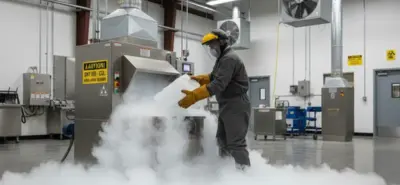
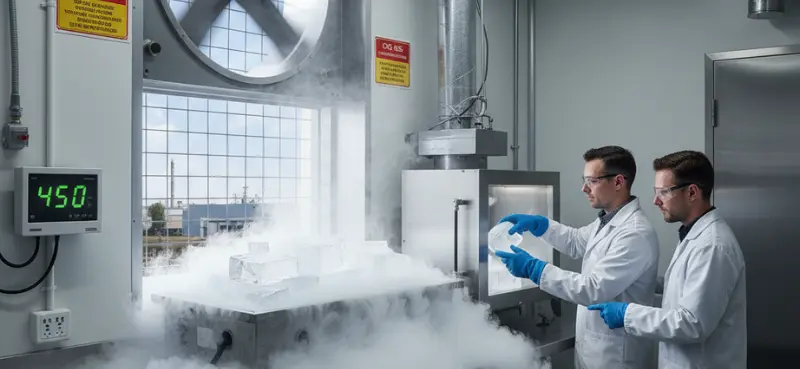
You know that moment when you open a package and a mysterious fog rolls out like something from a sci-fi movie? That’s dry ice doing its thing. But here’s what most people don’t realize:
The journey from gaseous carbon dioxide to those mesmerizing smoking pellets involves some seriously clever chemistry and engineering. I’ve spent years watching this transformation up close, and honestly? It never gets old. Whether you’re a restaurant owner in Abu Dhabi looking to preserve premium ingredients or planning an epic event with dramatic fog effects, understanding how Dry Ice Abu Dhabi is manufactured and distributed will completely change how you think about this remarkable substance.
The whole process is like watching nature’s laws bend to industrial precision. Carbon dioxide, the same gas we exhale with every breath, gets transformed into a solid that’s colder than your freezer could ever dream of reaching.
And the best part? The dry ice supply industry in the UAE has evolved tremendously, with delivery options that would have seemed impossible just a decade ago.
The Science Behind Dry Ice Production: Where Does It All Begin?
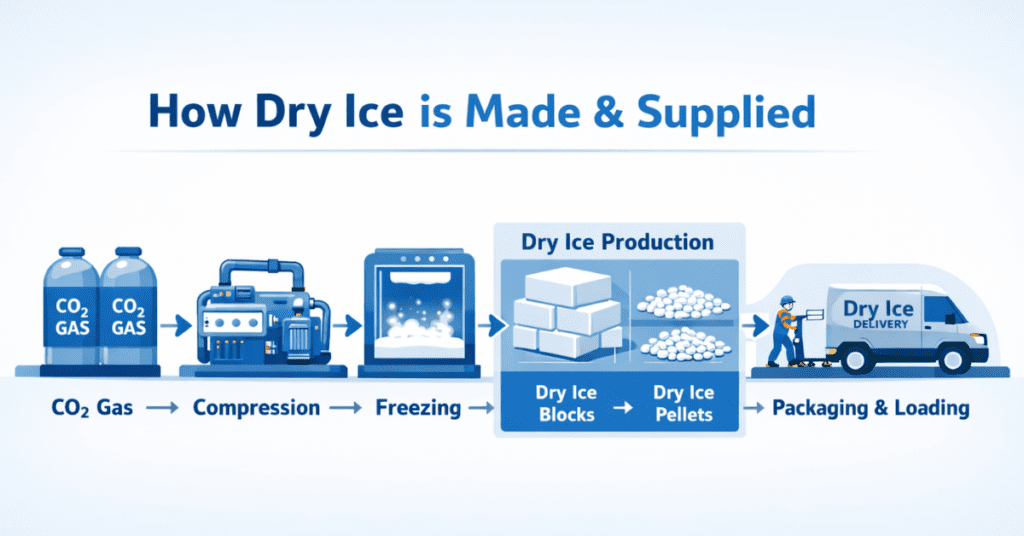
Let me break this down in a way that makes sense. Dry ice doesn’t grow on trees or get mined from the earth. The raw material is carbon dioxide gas, and the manufacturing process is all about manipulating temperature and pressure to skip the liquid phase entirely. That’s right: we go straight from gas to solid.
Here’s where it gets interesting. Carbon dioxide exists everywhere around us, but commercial dry ice production typically starts with industrial byproducts. Factories making ammonia, ethanol, or other chemicals produce CO2 as a natural consequence of their processes. Smart manufacturers capture this waste gas instead of releasing it into the atmosphere. It’s recycling at its finest, honestly.
The purification stage is crucial and absolutely non-negotiable. You can’t just compress any old CO2 and expect quality dry ice. The gas needs to be medical-grade pure, especially for food applications. We’re talking 99.99% purity levels here. Any moisture, oil, or contaminants get stripped out through multiple filtration stages.
This meticulous attention to quality matters tremendously when you’re looking to Find Dry Ice near me for restaurants, medical facilities, or any application where purity directly impacts safety and effectiveness.
What Happens During Compression and Expansion?
Now we’re getting to the magic part. The purified CO2 gas enters massive compressors that squeeze it down to approximately 870 psi. That’s about 60 times the pressure in your car tires. This compression alone doesn’t create dry ice, though. It creates liquid CO2, which might sound counterintuitive given what I said earlier about skipping the liquid phase.
But here’s the clever bit: when you suddenly release that pressurized liquid CO2 into normal atmospheric pressure, thermodynamics takes over. The rapid expansion causes the temperature to plummet instantaneously. We’re talking about going from liquid at room temperature to solid at minus 78.5 degrees Celsius in the blink of an eye. Some of the CO2 vaporizes immediately, carrying away heat and freezing the rest into snow-like crystals.
This CO2 snow gets collected in what looks like a giant snow cone maker. The fluffy white material has the consistency of fresh powder snow, except it’s sublimating constantly, creating that characteristic fog. At this stage, it’s not yet in the form most customers want. That’s where the next step comes in.
The temperature drop during expansion is dramatic and happens almost instantaneously. Imagine liquid CO2 at around -20°C suddenly exposed to atmospheric pressure. Within milliseconds, it plummets to -78.5°C. This rapid transformation explains why the snow appears so quickly and why production facilities need robust safety protocols.
What’s particularly fascinating about this process is its efficiency. Modern production facilities can convert up to 40% of the liquid CO2 into solid dry ice, with the remaining 60% vaporizing during the cooling process. That might sound wasteful, but it’s actually quite remarkable considering the thermodynamic challenges involved. The vaporized CO2 gets recaptured and recompressed, creating a closed-loop system that minimizes waste.
The collection chambers where the snow accumulates operate at controlled temperatures and pressures. Engineers carefully monitor these conditions because even slight variations can affect the final product’s density and sublimation rate. Too warm, and you get loose, fluffy snow that sublimates rapidly. Too cold with excessive pressure, and you might get uneven crystallization that creates quality issues down the line.
How Does Dry Ice Transform From Snow to Pellets and Blocks?
The CO2 snow gets fed into hydraulic presses that compress it into dense blocks or extrude it through dies to create pellets. Think of it like pasta-making, but with sublimating ice instead of dough. The pressure forces the snow crystals together, eliminating air pockets and creating solid dry ice with consistent density.
For blocks, massive rectangular molds receive the snow and get compressed under several tons of pressure. These blocks typically measure around 10 inches by 10 inches and weigh approximately 22 kilograms. They’re perfect for shipping temperature-sensitive goods over long distances because their lower surface-area-to-volume ratio means slower sublimation rates.
Pellets, on the other hand, come in various diameters. The most common sizes in Abu Dhabi are 3mm, 9mm, and 16mm. Each size serves different purposes:
Small pellets (3mm) work brilliantly for blast cleaning applications where you need gentle abrasive action without damaging substrates
Medium pellets (9mm) are the workhorses for shipping and cold chain logistics, offering a great balance between handling ease and cooling power
Large pellets (16mm) excel in industrial cooling applications where maximum cold retention matters more than surface contact
The extrusion process for pellets is continuous, with the snow getting pushed through circular dies at controlled rates. The extruded rods break naturally into pellet lengths as they exit the die. No cutting required, which is pretty neat when you think about it.
The density of the final product matters tremendously. Under-compressed dry ice sublimates too quickly, making it impractical for most applications. Over-compressed dry ice becomes brittle and prone to shattering, which creates handling difficulties and safety concerns. Manufacturers aim for that sweet spot where the pellets or blocks are dense enough for slow sublimation but not so compact that they become fragile.
Quality control happens throughout the compression stage. Operators monitor pellet diameter, density readings, and visual appearance. Any deviation from specifications triggers immediate adjustments to the hydraulic pressure or extrusion speed. This attention to detail ensures every batch meets the same high standards that customers expect.
The blocks require special handling immediately after pressing. They’re extremely cold and fragile for the first few minutes after formation. Workers use specialized gripping tools and transport carts designed specifically for dry ice. The blocks get transferred directly into insulated storage containers where they stabilize and develop their characteristic hardness.
Temperature monitoring continues even during storage. While dry ice is obviously cold, maintaining optimal storage conditions prevents unnecessary sublimation loss. The storage areas feature thick insulation, minimal air circulation, and careful inventory rotation to ensure customers always receive the freshest product with maximum remaining life.
Is Dry Ice Food Grade in Abu Dhabi? Quality Control Standards Explained
This question comes up constantly, and rightfully so. When you’re using dry ice to preserve food or create cocktail effects, purity isn’t just nice to have. It’s absolutely essential. Food-grade dry ice must meet strict regulatory standards that govern every step from CO2 sourcing through final packaging.
In the UAE, reputable suppliers like DryiceAbudhabi follow international food safety protocols including HACCP (Hazard Analysis and Critical Control Points) certification. The entire production chain gets monitored for potential contamination risks. We’re talking about regular testing for:
Moisture content, which should be virtually zero
Oil and grease residues from compression equipment
Metallic particles from manufacturing machinery
Biological contaminants including bacteria and mold spores
Chemical impurities from the source CO2
The testing happens at multiple points. Initial CO2 gas samples before compression, mid-process checks during pelletization, and final product verification before packaging. Any batch that doesn’t meet specifications gets recycled back into the system. Zero compromise on this front.
This rigorous quality assurance is what separates professional Dry Ice in UAE suppliers from mediocre ones. Every step gets documented, creating a complete quality trail from raw CO2 through final delivery. Customers can request batch certificates showing test results for any shipment they receive.
How Does Dry Ice Get From Factory to Your Doorstep in Abu Dhabi?
Distributing dry ice presents unique challenges that don’t exist with regular ice or most other products. You’re dealing with a substance that’s constantly sublimating, losing approximately 5-10% of its mass every 24 hours even under optimal storage conditions. Time becomes everything in this business.
The supply chain starts the moment dry ice exits the production press. Workers immediately transfer blocks and pellets into specialized storage containers. These aren’t your typical freezers, by the way. Dry ice storage requires insulated containers that allow CO2 gas to vent safely while minimizing heat transfer from the environment.
Most suppliers in Abu Dhabi maintain strategically located distribution centers across the emirate. This geographic spread reduces delivery times dramatically. When you place an order for same-day delivery, the logistics system automatically routes your request to the nearest facility with available inventory.
The logistics software behind these operations is surprisingly sophisticated. It tracks real-time inventory levels at each location, monitors traffic patterns across Abu Dhabi, calculates optimal delivery routes, and even factors in weather conditions that might affect sublimation rates. All of this happens automatically within seconds of order submission.
Distribution centers operate on a just-in-time model. Rather than stockpiling massive quantities that would sublimate away, they coordinate closely with production facilities to maintain optimal inventory levels. Fresh batches arrive throughout the day, timed to match anticipated demand patterns. This approach minimizes waste while ensuring product availability.
During peak seasons, particularly summer months when cooling demands spike, distribution networks shift into high gear. Additional production runs, extended operating hours, and temporary storage expansions ensure supply keeps pace with demand. The industry has learned from experience that running out of stock during a heatwave means losing customers who can’t afford to wait.
What Makes Dry Ice Transportation Different From Regular Ice?
Regular ice melts into water. Inconvenient, sure, but not particularly dangerous. Dry ice sublimates directly into CO2 gas, which can displace oxygen in enclosed spaces. This means every transport vehicle needs proper ventilation systems. Drivers receive specific training on handling protocols and emergency procedures.
The packaging itself tells a story about engineering problem-solving. Most deliveries use expanded polystyrene (EPS) containers, sometimes called styrofoam boxes, with varying thicknesses depending on delivery distance and ambient temperature. For longer routes during summer months when Abu Dhabi temperatures soar past 45°C, double-walled containers with vacuum insulation come into play.
Here’s something I find fascinating: the containers always include venting mechanisms. Completely sealing dry ice creates pressure buildup as sublimation continues. Those little holes you might notice in delivery boxes aren’t defects. They’re deliberate safety features that allow gas escape while maintaining insulation effectiveness.
Delivery vehicles themselves get equipped with temperature monitoring systems. Real-time tracking doesn’t just tell customers where their order is; it monitors cargo bay temperatures to ensure optimal preservation conditions throughout transit. If temperatures rise unexpectedly, the system alerts both driver and dispatch center immediately.
This level of sophistication in logistics is what makes modern Dry Ice supply near me services so reliable. The entire delivery chain operates with precision timing and constant monitoring to ensure you receive product in optimal condition.
Where Can I Buy Dry Ice in Abu Dhabi? Local Production Advantages
The UAE has developed a robust local dry ice manufacturing industry over the past decade. This wasn’t always the case. Ten years ago, most dry ice got imported from neighboring countries, which meant longer lead times, higher costs, and quality concerns from extended storage periods.
Local production changed everything. DryiceAbudhabi operates state-of-the-art facilities right here in the emirate, producing fresh dry ice daily. This proximity to end users creates multiple advantages:
Fresher product with minimal sublimation loss before delivery
Faster response times for urgent or same-day orders
Better pricing due to eliminated import costs and duties
Consistent quality control under local regulatory oversight
Reduced environmental impact from shorter transportation distances
The industrial zones around Abu Dhabi provide ideal conditions for dry ice manufacturing. Many facilities locate near petrochemical complexes that produce abundant CO2 as a byproduct. This geographical synergy means shorter CO2 transportation distances and lower raw material costs, savings that often get passed to customers.
Can I Get Same-Day Dry Ice Delivery in Abu Dhabi?
Absolutely, and this capability has transformed how businesses and individuals access dry ice. Modern suppliers operate sophisticated online ordering platforms that process requests 24/7. The system works remarkably smoothly.
You log onto the website, specify your requirements (pellet size, quantity, delivery time), and submit the order. Behind the scenes, the platform checks inventory at nearby distribution centers, calculates optimal delivery routes, and confirms availability within minutes. Most same-day orders placed before noon get delivered the same afternoon.
Emergency orders receive priority handling. Restaurant freezer breaks down? Medical facility needs immediate cold storage? The system flags these as urgent and dispatches from the closest location with available drivers. I’ve seen turnaround times as quick as 90 minutes from order submission to doorstep delivery.
Payment options include cash on delivery, credit card, corporate accounts, and bank transfer. Business customers often establish standing orders that automatically replenish inventory on predetermined schedules. This automation eliminates the stress of monitoring stock levels and placing repeat orders manually.
What Are the Uses of Dry Ice in Abu Dhabi? Industry Applications
The applications span far wider than most people realize. Sure, everyone knows about keeping ice cream frozen during transport or creating spooky fog effects at parties. But the industrial and commercial uses showcase the real versatility of this remarkable substance.
Each application demands specific pellet sizes and quantities. Event planners typically order smaller amounts of larger pellets for maximum visual impact. Restaurants and caterers prefer medium pellets in bulk for consistent cold chain maintenance. Industrial clients often need specialized delivery schedules coordinated with production cycles.
How to Handle and Store Dry Ice Safely? Essential Safety Guidelines
Let’s talk about something crucial that doesn’t get enough attention. Dry ice is incredibly useful, but it’s also potentially hazardous if mishandled. The extreme cold can cause frostbite instantly, and the sublimating CO2 gas can create asphyxiation risks in confined spaces. These aren’t theoretical dangers. They’re real concerns that require proper precautions.
Personal Protection:
Always wear insulated gloves when handling dry ice. Never touch it with bare skin. The minus 78.5°C temperature causes immediate tissue damage
Use tongs or scoops for transferring small quantities. Your gloves provide protection, but tools offer even better safety margins
Wear safety glasses if breaking blocks into smaller pieces. Flying chips can cause eye injuries
Keep dry ice away from children and pets. The smoking effect attracts curiosity, but the consequences of contact aren’t worth it
Storage Requirements:
Never store dry ice in airtight containers. The pressure buildup from sublimation can cause explosions. Always use ventilated storage
Regular freezers aren’t suitable for dry ice storage. The extreme cold actually tricks the thermostat into shutting off, which then warms the freezer and wastes the dry ice
Expanded polystyrene coolers work best for short-term storage. They provide insulation while allowing gas venting
Store in well-ventilated areas. Basements, small rooms, and vehicle trunks are dangerous because CO2 gas is heavier than air and accumulates at floor level
Label storage containers clearly. Other people need to know what they’re dealing with
Ventilation Considerations:
This point deserves special emphasis. One kilogram of dry ice produces approximately 540 liters of CO2 gas. In an enclosed space, this gas displaces oxygen. The symptoms of oxygen deprivation include headache, dizziness, rapid breathing, and eventually unconsciousness.
I’ve heard stories of people storing large quantities in car trunks overnight or using dry ice for party effects in poorly ventilated rooms. These situations can turn dangerous quickly. The gas is colorless and odorless, so you won’t notice it accumulating until symptoms appear.
For indoor use, ensure adequate air circulation. Open windows, use fans, avoid enclosed spaces. For vehicle transport, crack windows even during air-conditioned drives. The temporary discomfort of hot air beats the risk of CO2 accumulation.
How Much Does Dry Ice Cost in Abu Dhabi? Pricing and Ordering Guide
Pricing varies based on several factors. Quantity ordered, pellet size, delivery distance, and urgency all influence the final cost. Understanding these variables helps you optimize your purchasing decisions.
Most suppliers offer volume discounts. Ordering 50 kilograms costs significantly less per kilogram than buying 5 kilograms. Businesses with regular needs benefit from establishing wholesale accounts that provide preferential pricing and priority service.
Delivery fees depend on location and order urgency. Standard next-day delivery across Abu Dhabi typically includes free or minimal delivery charges for orders above a minimum threshold. Same-day or express delivery commands premium pricing due to the dedicated logistics required.
Pellet size also affects pricing. Smaller pellets require more precise manufacturing controls and thus cost slightly more than standard sizes. The difference isn’t huge, but it exists. Large blocks generally offer the best value per kilogram because they’re simpler to produce and have lower sublimation rates during storage.
Smart ordering strategies can reduce costs significantly:
Plan ahead when possible. Next-day delivery costs less than same-day rush orders
Consolidate orders. Multiple small orders cost more than one larger order delivered to the same location
Consider standing orders for regular needs. Automated deliveries often qualify for better pricing
Order only what you need. Dry ice sublimates regardless of use, so excess inventory becomes wasted money
Compare total cost including delivery, not just per-kilogram pricing. The cheapest unit price might have high delivery fees that eliminate savings
What Sizes of Dry Ice Pellets Are Available for Order?
Suppliers in Abu Dhabi typically stock three primary pellet sizes, each optimized for specific applications. The 3mm pellets work perfectly for blast cleaning operations where you need gentle abrasive action. These small pellets accelerate quickly in blast equipment and won’t damage delicate surfaces.
The 9mm pellets represent the workhorse size. They’re versatile enough for most cooling applications while offering good sublimation resistance. Restaurants, catering companies, and event planners typically prefer this size because it balances handling convenience with cooling efficiency.
The 16mm pellets excel in situations requiring maximum cold retention. Their lower surface-area-to-volume ratio means slower sublimation rates. Industrial applications needing prolonged cooling periods benefit most from this size.
Minimum order quantities vary by supplier but typically start around 5-10 kilograms for delivery orders. Walk-in customers can often purchase smaller quantities, though per-kilogram pricing increases for these small purchases. DryiceAbudhabi accommodates both large wholesale orders and smaller individual needs.
Is Dry Ice Environmentally Friendly? Sustainability Perspective
The environmental profile of dry ice presents interesting contradictions. On one hand, the production process captures CO2 that would otherwise enter the atmosphere as industrial waste. This recycling aspect provides genuine environmental benefits. On the other hand, the energy-intensive compression and refrigeration stages consume significant electricity.
The net impact depends largely on the CO2 source. Manufacturers capturing waste CO2 from ammonia or ethanol production create no additional greenhouse gas burden. They’re essentially borrowing atmospheric carbon temporarily for cooling applications before releasing it back as gas. This cycle doesn’t add new carbon to the atmosphere.
Compare this to alternatives like conventional refrigeration or gel ice packs. Refrigerated transport requires continuous power consumption throughout shipping. Gel packs need petroleum-based materials for manufacture and create disposal waste. Dry ice sublimates completely, leaving zero waste and requiring no return logistics or cleaning.
The UAE’s push toward renewable energy improves the sustainability equation further. As solar and nuclear power replace fossil fuel generation, the carbon footprint of dry ice production decreases proportionally. Future dry ice manufacturing may operate on entirely clean energy, making it genuinely carbon-neutral.
What Innovations Are Shaping the Dry Ice Industry in UAE?
The dry ice industry isn’t standing still. New technologies and methodologies continuously emerge, improving efficiency, safety, and environmental performance. Abu Dhabi suppliers are at the forefront of adopting these innovations, driven by the emirate’s commitment to technological advancement.
Automation has transformed production facilities over the past five years. Robotic systems now handle many tasks that previously required manual labor, from loading compression chambers to packaging finished products. This automation improves consistency, reduces workplace injuries, and allows for 24/7 production when demand requires it.
Smart monitoring systems represent another significant advancement. Internet-of-Things sensors track temperature, pressure, humidity, and CO2 levels throughout production and storage facilities. This real-time data feeds into analytical systems that predict equipment maintenance needs, optimize production schedules, and alert operators to potential quality issues before they affect customers.
Energy recovery systems are becoming standard in newer facilities. The compression process generates substantial heat as a byproduct. Rather than simply venting this heat, modern plants capture it for other uses like heating water, warming office spaces during cooler months, or even feeding back into industrial processes. This waste heat recovery can reduce overall energy consumption by 15-20%.
Research into improved insulation materials continues to advance. Newer delivery containers use advanced vacuum-insulated panels that outperform traditional expanded polystyrene while being thinner and lighter. This means lower shipping costs, reduced sublimation losses during transit, and better environmental performance through material efficiency.
The integration of renewable energy directly into production facilities is gaining momentum. Some newer dry ice plants in the UAE incorporate rooftop solar arrays that offset a portion of their electricity consumption. While solar alone can’t power the energy-intensive compression equipment completely, every kilowatt-hour from clean sources improves the environmental equation.
Customer-facing technology has evolved significantly too. Mobile apps now let you track deliveries in real-time, adjust order quantities on the fly, and even scan QR codes on delivery containers to access product certificates and handling guidelines. This digital integration makes the entire ordering and receiving process smoother and more transparent.
Looking forward, the industry anticipates further innovations in pellet customization. Imagine ordering dry ice pellets in precisely the size and density needed for your specific application, manufactured on demand rather than selected from standard sizes. The technology to enable this level of customization is already being tested in advanced facilities.
Final Thoughts: Your Dry Ice Journey Starts Here
Understanding how dry ice is manufactured and supplied transforms it from a mysterious smoking substance into a sophisticated industrial product with fascinating chemistry. The journey from captured CO2 to those perfectly formed pellets sitting in your cooler involves precision engineering, quality control, and logistics coordination that most customers never see.
What started as industrial waste gas becomes an invaluable tool for countless applications across Abu Dhabi and the wider UAE. From preserving vaccines that save lives to creating unforgettable event moments, from enabling molecular gastronomy experiments to solving industrial cooling challenges, dry ice proves its versatility daily.
The local production infrastructure in Abu Dhabi means you’re never far from fresh, high-quality dry ice when you need it. Same-day delivery, food-grade certification, multiple pellet sizes, and competitive pricing make it easier than ever to access this remarkable substance.
Whether you’re running a restaurant, planning an event, managing a healthcare facility, or tackling an industrial project, quality dry ice supply matters. The difference between mediocre and excellent service often comes down to supplier reliability, product freshness, and delivery speed.
Ready to experience the difference that local production and professional service make? Visit DryiceAbudhabi online or contact their team to discuss your specific requirements. They’ll help you determine the right pellet size, quantity, and delivery schedule for your needs. Because when it comes to dry ice, you deserve a supplier who understands both the science and the service.
Frequently Asked Questions About Dry Ice in Abu Dhabi
Where can I buy dry ice in Abu Dhabi?
You can purchase high-quality dry ice from DryiceAbudhabi, which operates production facilities and distribution centers across the emirate with convenient online ordering and same-day delivery options.
Where to buy dry ice in Abu Dhabi for urgent needs?
For urgent requirements, DryiceAbudhabi provides same-day delivery service throughout Abu Dhabi with orders placed before noon typically arriving within 3-4 hours.
Do you provide dry ice delivery in Abu Dhabi?
Yes, DryiceAbudhabi offers comprehensive delivery services covering all areas of Abu Dhabi with standard next-day delivery and express same-day options for time-sensitive requirements.
How much does dry ice cost in Abu Dhabi?
Dry ice pricing in Abu Dhabi varies based on quantity, pellet size, and delivery requirements, with DryiceAbudhabi offering competitive wholesale pricing and volume discounts for bulk orders.
Is dry ice food grade in Abu Dhabi suppliers?
Absolutely, DryiceAbudhabi produces food-grade dry ice that meets international safety standards and HACCP certification requirements with rigorous testing for complete safety in all food contact applications.
What sizes of dry ice pellets are available?
DryiceAbudhabi stocks three standard pellet sizes: 3mm for blast cleaning, 9mm for general cooling and food preservation, and 16mm for maximum cold retention in industrial applications.
How fast is dry ice delivery in Abu Dhabi?
Standard delivery from DryiceAbudhabi typically completes within 24 hours, while same-day delivery for orders placed before noon arrives within 3-4 hours across Abu Dhabi.
Can I get same-day dry ice in Abu Dhabi?
Yes, same-day service is readily available through DryiceAbudhabi’s delivery network, with the online ordering system automatically checking inventory at nearby distribution centers for immediate confirmation.
What are uses of dry ice in Abu Dhabi?
Dry ice applications in Abu Dhabi include food service cold chain shipping, healthcare vaccine transport, industrial blast cleaning, special effects for events, aviation catering, and construction concrete cooling with DryiceAbudhabi serving all sectors.
How to handle and store dry ice safely?
Safe dry ice handling requires insulated gloves, proper ventilation, and ventilated storage containers, with DryiceAbudhabi providing detailed safety guidelines with every delivery to ensure proper handling practices.
Ever found yourself frantically searching for “dry ice near me” at 11 PM because your event is tomorrow and you need it ASAP? Yeah, I’ve been there. Let me tell you choosing the right dry ice supplier in UAE isn’t just about finding someone who has the product. It’s about reliability, quality, and knowing you won’t be left scrambling when you need it most.
Whether you’re preserving seafood at Abu Dhabi’s fish market, creating show-stopping effects at a wedding in Emirates Palace, or shipping temperature-sensitive medical supplies across the Emirates, finding the perfect dry ice supply partner can make or break your operation. In Abu Dhabi’s scorching climate where temperatures soar past 45°C during summer months, having access to quality dry ice isn’t a luxury it’s absolutely essential for business continuity.
I’ve spent years working with different suppliers across the UAE, and trust me when I say that not all dry ice is created equal. Some suppliers will promise you the moon but deliver inconsistent quality that leaves your products compromised. Others might have a great product but terrible delivery times that throw your entire schedule into chaos. And don’t even get me started on those who disappear when you need them most like Friday afternoons or during Ramadan.
That’s why I’ve put together this comprehensive guide to help you navigate the sometimes-confusing world of dry ice procurement. Think of this as your roadmap to finding a supplier who doesn’t just sell you frozen CO₂, but becomes a genuine partner in your success.
Why Does Your Choice of Dry Ice Supplier Matter in Abu Dhabi?
Picture this: You’re running a high-end restaurant in Abu Dhabi’s Marina district. Your molecular gastronomy menu depends on dry ice for those Instagram-worthy presentations that keep customers coming back. Your supplier just called they can’t deliver today. No dry ice means no signature dishes. Your reputation? On thin ice (pun absolutely intended).
The UAE market demands precision and reliability. From the pharmaceutical companies in KIZAD handling million-dirham vaccine shipments to the event planners orchestrating lavish weddings at Qasr Al Watan, everyone needs a supplier who gets it. And here’s something many people don’t realize Abu Dhabi isn’t Dubai. The logistics are different, the delivery zones vary, the regulations have subtle differences, and you need someone who understands the local landscape intimately.
Understanding the various dry ice uses helps you realize why supplier quality matters so much. Whether it’s blast freezing fresh hamour at the harbor, creating dramatic fog effects for corporate events at ADNEC, maintaining cold chain logistics for vaccines heading to remote clinics in Al Ain, or emergency cooling during those dreaded power outages each application demands consistent quality and reliable delivery. One bad batch or missed delivery can cost you thousands of dirhams or damage your reputation beyond repair.
Factor #1: What’s the Quality and Purity of Their Dry Ice?
Here’s a secret that most people don’t realize until it’s too late: not all dry ice is food-grade. I learned this the hard way when a client once used industrial-grade dry ice for a cocktail event at a luxury hotel. The health inspector wasn’t just unamused he shut down the entire bar service for three days. Talk about an expensive lesson.
When evaluating dry ice Abu Dhabi suppliers, you need to ask the tough questions that separate professionals from pretenders:
Is it food-grade certified? If you’re in the F&B, pharmaceutical, or medical industries, this isn’t negotiable. You need documentation proving compliance with food safety standards.
What’s the CO₂ purity level? Premium suppliers should offer 99.9% pure CO₂. Anything less means impurities that can affect taste, safety, and sublimation rates.
Do they provide certificates of analysis? Any serious supplier should hand these over without you having to beg. These certificates prove what they’re selling you.
How do they store it before delivery? Poor storage equals faster sublimation, which means you’re literally paying for air. Good suppliers use specialized containers that minimize loss.
What’s their production process? Understanding how they make it tells you a lot about quality control. Modern equipment produces cleaner, denser ice.
DryiceAbudhabi maintains strict quality controls throughout its production process, ensuring every batch meets international food-grade standards. When you’re choosing between suppliers, don’t just take their word for it ask to see documentation, request sample testing, and verify their certifications independently.
Factor #2: Can They Actually Deliver When You Need It?
I cannot stress this enough: in the dry ice game, timing is everything. You can’t stockpile this stuff in your garage like you’re preparing for the apocalypse. It sublimates constantly, relentlessly losing about 5-10% of its mass every 24 hours even under ideal storage conditions. In Abu Dhabi’s brutal summer heat, that rate can accelerate dramatically if you don’t have proper storage.
When searching for “dry ice supply near me“, proximity matters, but reliability matters infinitely more. I’d rather work with a supplier 30 minutes away who delivers on time every single time than one five minutes away who’s constantly making excuses. Here’s what separates the professionals from the amateurs:
Same-day delivery capabilities across Abu Dhabi – Because emergencies don’t schedule appointments, and your seafood shipment won’t wait until tomorrow
Extended coverage area – Can they reach Al Ain reliably? What about Liwa? The industrial zones in Mussafah? Al Raha Beach? Coverage maps matter.
Flexible ordering options – Online ordering, phone calls, WhatsApp Business (yes, this is the UAE, WhatsApp absolutely counts as a legitimate business channel)
Emergency response protocols – What happens when you need 100kg at 7 PM on a Thursday evening? Do they have after-hours support? Emergency contact numbers?
Real-time tracking systems – You should know exactly when your delivery is arriving, not just get a vague “sometime this afternoon” response
Consistent delivery windows – If they say 2-4 PM, it should arrive between 2-4 PM, not 6 PM with apologies
Factor #3: What Product Variety Do They Offer?
One size definitely does not fit all when it comes to dry ice. The massive blocks you use for shipping frozen goods internationally aren’t the same as the pellets you need for blast freezing fresh fish or creating theatrical fog effects. And trying to use the wrong format? That’s like bringing a knife to a gunfight you’ll lose badly.
A professional, full-service supplier should offer multiple formats to match different applications. Here’s what you should expect:
Product Type
Best For
Typical Sizes
Dry Ice Blocks
Long-distance shipping, large-scale cooling, extended storage, and marine transport
5kg, 10kg, 25kg slabs
Dry Ice Pellets
Blast freezing, industrial cleaning, special effects, laboratory research, food processing
Understanding how to produce dry ice helps you appreciate why different formats exist and why they can’t be used interchangeably. Pellets require different compression and extrusion processes than blocks, each serving very distinct purposes with specific density characteristics. A supplier who only offers one format is severely limiting your operational flexibility and probably isn’t serious about serving diverse customer needs.
Factor #4: Are Their Prices Competitive and Transparent?
Let’s talk money, because nobody likes surprises on their invoice. Well, except maybe surprise discounts those are cool, I’ll take those any day.
In the UAE market, dry ice pricing can vary wildly depending on who you talk to. I’ve seen quotes range from AED 4 to AED 12 per kilogram depending on the supplier, quantity ordered, delivery requirements, product format, and whether Mercury is in retrograde (okay, maybe not that last one). But here’s the thing the cheapest option isn’t always the best deal, and the most expensive isn’t necessarily premium quality.
Red flags to watch for when evaluating pricing:
Hidden delivery charges that magically appear at billing time. “Oh, didn’t we mention the fuel surcharge? And the weekend premium? And the…”
“Market price” listings without actual numbers. What market? The fish market? Stock market? Flea market? Come on, give me real numbers.
Unrealistic minimum order quantities that make sense for a hotel chain but not your small café trying to do dry ice cocktails
No bulk discounts for regular customers – Loyalty should count for something. If you’re ordering every week, that deserves better rates.
Inconsistent pricing that changes every single time you call, like they’re making it up on the spot
A good dry ice supplies company will be completely upfront about costs from the first conversation. They’ll explain exactly what drives pricing quantity breaks, delivery distance, pellet size, urgency levels, and more then work with you to find a solution that fits your budget without compromising quality. DryiceAbudhabi offers transparent pricing structures and volume discounts for regular customers because they understand that maintaining long-term relationships matters infinitely more than maximizing profit on one-off sales.
Factor #5: Do They Prioritize Safety and Proper Handling?
Okay, real talk time. Dry ice is absolutely incredible for what it does, but it’s also genuinely dangerous if you don’t respect it properly. At -78.5°C (-109.3°F), this stuff can cause severe frostbite in literally seconds. Carbon dioxide buildup in enclosed spaces? That’s a suffocation hazard that has killed people. This isn’t fear-mongering it’s physics.
A responsible supplier doesn’t just hand over the product, take your money, and wave goodbye with a cheerful “good luck!” They should actively ensure you know how to use it safely:
Provide comprehensive handling instructions – In both English and Arabic, because safety information doesn’t have a language barrier and shouldn’t exclude anyone
Deliver in appropriate containers – Not just any random cooler they grabbed from the warehouse, but properly insulated containers designed for dry ice
Offer safety training sessions – Especially critical for first-time users or when you’re using it for new applications you haven’t tried before
Supply or recommend protective equipment – Proper insulated gloves rated for cryogenic temperatures, not your grandmother’s oven mitts or regular winter gloves
Have clear emergency protocols – What happens if something goes wrong? Who do you call? What are the first aid procedures for frostbite or exposure?
Factor #6: What’s Their Customer Service and Support Like?
You know what really separates a decent supplier from an exceptional one? How they treat you when things inevitably go sideways. Because they will that’s not pessimism, that’s just reality in business.
I’ve dealt with suppliers who completely ghost you after 5 PM, as they transform into pumpkins at sunset. Others who act like you’re personally insulting their ancestors by asking a question. And then there are the absolute gems the suppliers who genuinely care about solving your problems and treating you like a valued partner, not just another order number.
Essential customer service features to demand:
Responsive communication across multiple channels – Email, phone, WhatsApp whatever channel you prefer should get timely responses, ideally within an hour during business hours
Genuinely knowledgeable staff – Can they answer technical questions accurately? Recommend the right product for your specific application? Guide first-timers through the process patiently?
Flexible, creative problem-solving – When plan A fails spectacularly, do they have plans B, C, and D ready? Or do they just shrug and wish you luck?
Comprehensive after-sales support – Issues with storage? Questions about optimal application methods? They should remain available and helpful even after payment clears
Dedicated account management – For regular customers, having a dedicated contact person who knows your business and specific needs is absolutely invaluabl
True bilingual support – In the UAE, comprehensive Arabic and English support should be standard, not an afterthought or premium feature
How Do You Find the Best Dry Ice Supplier Near You in Abu Dhabi?
Alright, you’ve got the criteria, you know what to look for, you’re ready to start the hunt. Now what? Here’s my tried-and-tested, battle-hardened approach for finding a reliable dry ice supplier who’ll actually have your back:
Step 1: Research and Create Your Shortlist
Start with a comprehensive Google search for “dry ice UAE” or “dry ice Dubai” if you’re operating in the northern emirates. But here’s a crucial tip: look beyond just the first paid advertisement. Sometimes the absolute best suppliers aren’t the ones spending massive budgets on Google Ads they’re too busy actually serving customers well. Check detailed reviews on Google My Business, looking for patterns in feedback. Ask in industry-specific groups on LinkedIn or Facebook. Call your professional network and ask who they use. Word-of-mouth recommendations in the UAE business community are worth their weight in gold.
Step 2: Thoroughly Vet Your Options
Don’t just call one supplier and immediately commit. Talk to at least three different companies, preferably five if you have time. Ask all those tough questions I mentioned earlier about quality, delivery, safety, and pricing. Request detailed quotes in writing not vague estimates, but actual documented pricing. Verify they have proper business licenses and appropriate insurance coverage (yes, this absolutely matters, especially for commercial use and liability protection).
Step 3: Start Small and Test the Waters
Place a modest test order before committing to any long-term contract or bulk arrangement. See how they actually handle the entire process from order to delivery. Was the delivery truly on time as promised? Product quality exactly as specified? Customer service responsive and helpful throughout? Any issues that arose how were they handled? This trial run is genuinely worth its weight in, well, dry ice. It reveals their true colors.
Step 4: Build and Maintain the Relationship
Once you finally find a truly good supplier and they do exist, I promise nurture that business relationship carefully. Pay invoices on time consistently, communicate your evolving needs clearly and proactively, provide constructive feedback (both positive and negative), and treat them with the same respect and professionalism you expect in return. The very best supplier partnerships are built on foundations of mutual respect and reliability, not just transactional exchanges. Companies like DryiceAbudhabi actively work closely with their regular customers to deeply understand their evolving needs and provide increasingly customized solutions over time.
Your Next Steps: Choosing Your Dry Ice Partner in Abu Dhabi
Look, I get it completely. Choosing a supplier seems like just another mundane business decision on your endless to-do list. But in reality? It’s a partnership that can genuinely make or break your operations.
Whether you’re launching an innovative molecular gastronomy restaurant, managing critical pharmaceutical logistics, planning the wedding of the year, or running an industrial facility that depends entirely on reliable cooling solutions your dry ice supplier isn’t just a vendor. They’re an integral part of your operational team.
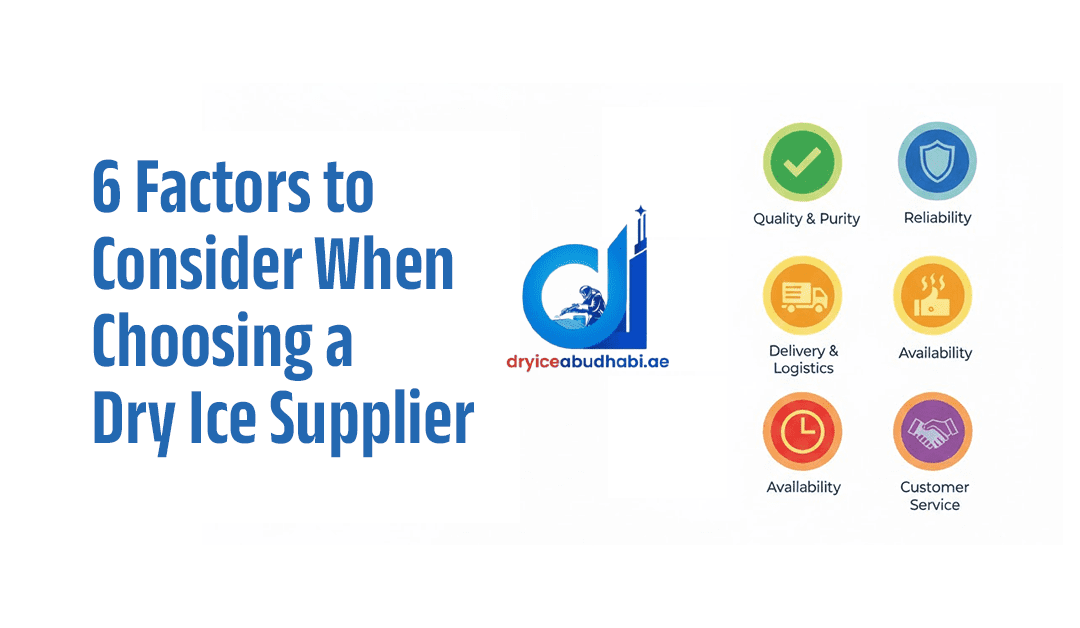
Remember those six critical factors we discussed in detail:
Quality and purity (because mediocre simply isn’t acceptable)
Delivery reliability (timing truly is everything)
Product variety (one size absolutely doesn’t fit all)
Transparent pricing (no hidden surprises)
Safety commitment (it’s literally freezing cold and potentially hazardous)
Customer service excellence (because relationships genuinely matter)
Don’t settle for the first supplier you happen to find. Do your homework thoroughly. Ask all the tough questions without hesitation. Test the waters carefully with a small initial order. And when you finally find that perfect match the supplier who consistently delivers quality product on time, treats you with genuine respect, and authentically cares about your success hold onto them tightly.
Ready to find your ideal dry ice partner? Start by reaching out to established, reputable providers like DryiceAbudhabi, compare your options systematically, ask all the tough questions without hesitation, and make an informed decision that’ll serve your business successfully for years to come.
Your operations deserve nothing less than excellence.
Frequently Asked Questions About Dry Ice in UAE
What is dry ice and why is it so useful?
Dry ice is the solid form of carbon dioxide (CO₂) that uniquely skips the liquid phase entirely and goes directly from solid to gas a process called sublimation. It’s incredibly useful because it maintains a consistent temperature of -78.5°C, making it perfect for flash freezing, shipping temperature-sensitive perishables, creating dramatic special effects, and countless industrial applications. In Abu Dhabi’s extreme heat, DryiceAbudhabi supplies this essential cooling solution to businesses across hospitality, healthcare, logistics, and entertainment sectors.
How is dry ice made and why does production quality matter?
Dry ice is made by compressing and rapidly cooling liquid CO₂ until it forms snow, which is then compressed into solid blocks or carefully extruded into pellets of various sizes. Production quality matters immensely because impurities directly affect both the sublimation rate and safety for food-grade applications. DryiceAbudhabi uses state-of-the-art production equipment that ensures 99.9% CO₂ purity and maintains strict quality controls throughout the entire manufacturing process, resulting in cleaner, denser, longer-lasting dry ice.
What is the temperature of dry ice and how should I handle it safely?
Dry ice maintains a consistent temperature of -78.5°C (-109.3°F). Never handle it with bare hands under any circumstances always use insulated gloves or appropriate tongs. Store it only in ventilated containers (never airtight) and ensure adequate ventilation in storage areas to prevent dangerous CO₂ buildup. When you order from DryiceAbudhabi, they provide comprehensive handling instructions and detailed safety guidelines to ensure you can use the product safely and effectively.
How long does dry ice last and what affects its sublimation rate?
In a typical styrofoam cooler, dry ice loses approximately 5-10% of its mass every 24 hours through natural sublimation. In Abu Dhabi’s extreme climate, sublimation accelerates significantly without proper storage. Factors affecting longevity include storage container quality, ambient temperature, dry ice form (blocks last considerably longer than pellets), and frequency of container opening. DryiceAbudhabi offers specialized storage solutions and delivery timing recommendations to maximize your product’s useful life.
Can dry ice be used in food and drinks safely in UAE?
Yes, but only food-grade dry ice should ever be used for culinary applications. Never consume dry ice directly it causes severe tissue damage. For cocktails and presentations, ensure pieces are sublimated completely before consumption, or use them only for visual effect outside the beverage. All dry ice from DryiceAbudhabi is food-grade certified and safe for use in F&B applications when proper handling protocols are followed.
What are the common uses of dry ice in UAE industries?
In the UAE, dry ice serves critical functions across multiple sectors: pharmaceutical cold chain logistics for vaccines and medications, seafood flash-freezing at fishing ports, airline catering services, special effects for events and weddings, industrial cleaning through dry ice blasting, laboratory research applications, and emergency cooling during power outages. DryiceAbudhabi supports all these industries with reliable supply and technical expertise.
Ever watched smoke cascade dramatically across a stage or wondered how your frozen gelato arrives at your doorstep still perfectly chilled? That’s dry ice working its magic. I’ll be honest with you when I first encountered dry ice, I thought it was just regular ice that someone forgot to wet. Boy, was I wrong. If you’re searching for a reliableDry Ice Abu Dhabi supplier, you’re in the right place to understand everything this remarkable substance offers.
Here’s the thing: dry ice isn’t ice at all. It’s frozen carbon dioxide, and it’s revolutionizing everything from food preservation to industrial cleaning across the UAE. Whether you’re looking for a reliable dry ice supplier or trying to understand if this frosty marvel is right for your business, you’ve landed in the right place.
Finding dry ice near me used to feel like searching for a needle in a haystack. But times have changed, especially here in Abu Dhabi where DryiceAbudhabi has made sourcing quality CO2 dry ice as easy as ordering your morning coffee. Let me walk you through everything you need to know about this incredibly versatile substance.
What Makes Dry Ice So Special?
Picture this: you’re at -78.5°C (-109.3°F), and instead of melting into a puddle like regular ice, this stuff simply vanishes into thin air. That’s sublimation, folksgoing straight from solid to gas without the messy liquid phase. It’s like a disappearing act that would make Houdini jealous.
The market for dry ice in UAE has exploded in recent years, and for good reason. From the bustling food scene in Abu Dhabi to pharmaceutical companies maintaining cold chains, everyone’s catching on to what makes this frozen CO2 so indispensable. As a dry ice supplier serving the region, DryiceAbudhabi has seen firsthand how businesses are incorporating dry ice pellets and blocks into their operations.
What really sets dry ice apart? It’s colder than your ex’s heart (sorry, couldn’t resist), leaves no residue, and doesn’t contaminate whatever it’s cooling. You get pure, food-grade dry ice that does its job and disappears without a trace. Clean, efficient, and remarkably effective.
Why Should You Care About Dry Ice? (The Benefits Nobody Talks About)
Temperature Control That Actually Works
Let’s get real for a second. Traditional ice melts, creates a mess, and leaves you with soggy packaging. Dry ice? It maintains temperatures lower than any regular freezer can achieve. We’re talking about preserving everything from gourmet ice cream to temperature-sensitive medications without breaking a sweat (pun absolutely intended).
I’ve seen bakeries use it to keep wedding cakes pristine during scorching UAE summers, and pharmaceutical companies rely on it for vaccine transport. The versatility is genuinely impressive. When you source from a reputable dry ice manufacturer, you’re investing in reliability that regular cooling methods simply can’t match.
The Environmental Angle (Yes, Really)
Here’s something that might surprise you: dry ice is environmentally neutral. It’s made from recaptured CO2stuff that was already in the atmosphere. Unlike chemical refrigerants that can harm the ozone layer, dry ice sublimates back into the air as carbon dioxide, maintaining the natural carbon cycle.
Plus, there’s no water waste. In a region like the UAE where water conservation matters, that’s not trivial. Every kilogram of regular ice that melts is water you need to deal with. Dry ice? It vanishes, leaving your shipment or storage area completely dry.
Where Can You Actually Use Dry Ice? (Spoiler: Everywhere)
How Is Dry Ice Transforming the Food Industry?
Walk into any high-end restaurant in Abu Dhabi, and chances are they’re using dry ice for something. Maybe it’s creating theatrical smoke effects for desserts, or perhaps they’re flash-freezing ingredients for molecular gastronomy. But beyond the showmanship, there’s serious utility here.
Food-grade dry ice keeps perishables fresh during transport. Ever wondered how seafood catches from the morning reaches Dubai restaurants by evening, still ocean-fresh? Or how premium meats maintain their quality during distribution? That’s bulk dry ice doing the heavy lifting. Companies offering dry ice delivery near me have become essential partners for restaurants, caterers, and food distributors across the Emirates.
What About Industrial and Commercial Applications?
This is where things get really interesting. Dry ice blasting using dry ice pellets as a cleaning medium has revolutionized industrial maintenance. Unlike sandblasting or chemical cleaning, it’s non-abrasive and leaves zero secondary waste. You’re essentially cleaning with frozen CO2 that disappears.
Manufacturing facilities use it for shrink-fitting metal parts. Medical labs employ it for transporting biological samples. Event planners create stunning fog effects for concerts and weddings. The applications are limited only by imagination. As a bulk supplier of dry ice in Abu Dhabi and all over UAE, DryiceAbudhabi serves an incredibly diverse client baseeach with unique needs and creative applications.
How Do You Handle Dry Ice Safely? (The Stuff They Don’t Tell You)
What Are the Real Dangers of Dry Ice?
Let me be brutally honest: dry ice can hurt you if you’re careless. At -78.5°C, it can cause frostbite in seconds if it touches your skin directly. I’ve seen people treat it like regular ice and immediately regret it. Always and I mean always use insulated gloves or tongs when handling dry ice blocks or pellets.
Here’s another thing that catches people off guard: dry ice produces carbon dioxide gas as it sublimates. In enclosed spaces, this can displace oxygen and create suffocation risks. Sounds scary? It doesn’t have to be. Proper ventilation solves this completely. Never store dry ice in airtight containers or poorly ventilated rooms, and you’ll be fine.
When you purchase from a professional dry ice wholesaler like DryiceAbudhabi, you’ll receive proper handling instructions. Don’t skip reading them. Seriously. Your fingers will thank you.
What Essential Safety Equipment Do You Need?
The safety toolkit is surprisingly simple:
Insulated gloves: Not your regular winter gloves. Get proper cryogenic or thermal-insulated gloves designed for extreme cold handling.
Safety goggles: Protect your eyes from accidental splashes or fragments when breaking dry ice blocks.
Well-ventilated storage: This isn’t optional. Garages, warehouses with airflow, or outdoor storage areas work well.
Tongs or scoops: For transferring dry ice pellets without direct contact.
Styrofoam or specialized coolers: Regular coolers work, but specialized dry ice containers from your dry ice supplier are worth the investment for frequent users.
How Do You Store Dry Ice Without Losing Half of It?
What’s the Best Way to Store Dry Ice for Maximum Longevity?
Here’s the thing about dry ice: it’s going to sublimate no matter what you do. That’s physics, and there’s no arguing with physics. But you can significantly slow down the process with smart storage.
Styrofoam coolers are your best friend here. Not the cheap ones from the gas stationget thick-walled, high-quality coolers. Industrial dry ice users often invest in specialized dry ice storage containers that can extend shelf life considerably. When DryiceAbudhabi makes deliveries, they often recommend storage solutions based on the quantity and intended usage duration.
Never seal the container completely. Remember that sublimation we talked about? CO2 gas needs somewhere to go, or you’re building a pressure bomb. Leave ventilation gaps or use containers designed with pressure relief. It’s a simple detail that prevents both safety hazards and ruined storage containers.
How Long Does Dry Ice Actually Last?
Expectations versus reality time: in a standard cooler, you’re looking at about 18-24 hours before half your dry ice has sublimated. High-quality insulated containers can push this to 3-5 days, depending on the amount and form (blocks last longer than pellets).
Here’s a pro tip from someone who’s learned the hard way: order your dry ice as close to usage time as possible. That same-day or next-day dry ice delivery service that suppliers offer? It’s not just convenienceit’s a practical necessity. Fresh dry ice from a local dry ice supply near me is always going to outperform stuff that’s been sitting around.
Dry Ice Storage: Quick Comparison
Storage Method
Typical Duration
Best For
Standard Styrofoam Cooler
18-24 hours
Same-day events, short-term shipping
High-Quality Insulated Container
3-5 days
Multi-day storage, longer shipments
Specialized Dry Ice Container
Up to 1 week
Industrial use, bulk storage
How Do You Choose the Right Dry Ice Supplier?
What Should You Look for in a Dry Ice Wholesaler?
Not all dry ice is created equal, and neither are suppliers. I’ve learned this lesson more than once. Here’s what separates the pros from the amateurs:
First, freshness matters enormously. A reliable dry ice manufacturer should produce and deliver quickly. DryiceAbudhabi, for instance, maintains production facilities strategically located to serve Abu Dhabi and surrounding emirates with minimal lag time between production and delivery.
Second, variety in product forms. Sometimes you need dry ice pellets for blasting. Other times, large blocks for shipping. A good supplier offers options. Food-grade certification is non-negotiable if you’re in the food or pharmaceutical sectors don’t compromise here.
Third, delivery reliability. When you need dry ice, you usually need it now. Suppliers who offer flexible scheduling and emergency deliveries are worth their weight in gold (or frozen CO2, in this case).
Where Can I Find Dry Ice Near Me in the UAE?
The UAE market has evolved significantly. You no longer need to call around desperately asking, “Where can I find dry ice near me?” Dedicated suppliers like DryiceAbudhabi have established reliable distribution networks across the emirates. Whether you’re in Abu Dhabi, Dubai, Sharjah, or beyond, same-day dry ice supply is increasingly accessible. For immediate needs, check out dry ice uses and availability to understand what’s possible in your area.
Pro Tips for First-Time Dry Ice Users
What Common Mistakes Should You Avoid?
Let me save you from the mistakes I’ve watched countless newcomers make:
Don’t store dry ice in your regular freezer. Sounds counterintuitive, right? But dry ice is colder than your freezer’s thermostat setting. It can trigger the freezer to shut off, ruining your frozen food.
Never transport dry ice in a vehicle’s sealed trunk or passenger area without ventilation. Crack those windows! CO2 buildup in confined spaces is dangerous.
Don’t dispose of dry ice down sinks or toilets. The extreme cold can crack pipes. Let it sublimate in a well-ventilated area instead.
Avoid touching dry ice with bare hands, even briefly. That ‘just a quick touch’ becomes frostbite faster than you think.
Don’t order too far in advance. Dry ice waits for no one order as close to usage time as your dry ice delivery service allows.
How Can You Maximize Your Dry Ice Investment?
Getting the most from your dry ice purchase isn’t rocket science, but there are smart strategies:
Use it strategically. Place items that need the most cooling closest to the dry ice. Create layers with newspaper or cardboard between dry ice and products to prevent freeze damage on delicate items while maintaining cold temperatures.
Minimize container opening. Every time you open your cooler, you’re releasing cold CO2 gas and introducing warm air. Plan ahead so you’re not constantly accessing the container.
Calculate quantities accurately. Your dry ice supplier can help here. DryiceAbudhabi, for instance, provides calculation assistance based on your cooling duration needs and container size. It’s better to have slightly more than run out halfway through an event or shipment.
Understanding Dry Ice and Sustainability
Is Dry Ice Environmentally Friendly?
This question comes up constantly, and the answer is nuanced. Dry ice production typically uses recaptured CO2 carbon dioxide that’s a byproduct of other industrial processes. Rather than releasing this CO2 directly into the atmosphere, it’s captured, purified, and frozen into dry ice.
When dry ice sublimates, it returns to the atmosphere as CO2. In terms of carbon footprint, you’re not adding new carbon; you’re temporarily sequestering it. Compared to traditional refrigeration systems using chemical refrigerants (some of which are potent greenhouse gases), dry ice comes out favorably.
Industrial dry ice applications, particularly dry ice blasting, offer environmental advantages over traditional cleaning methods. No chemical solvents, no abrasive waste, no water consumption just efficient cleaning that leaves only the removed contaminants to dispose of.
Industry-Specific Applications Worth Knowing
How Does the Healthcare Sector Use Dry Ice?
Medical and pharmaceutical applications demand the highest quality standards. Vaccine storage and transport especially for temperature-sensitive vaccinesrelies heavily on dry ice. Biological samples, tissue preservation, and organ transport all utilize dry ice for maintaining ultra-cold temperatures.
The COVID-19 pandemic highlighted this dramatically when certain vaccines required -70°C storage. Dry ice became absolutely critical in the distribution chain. Healthcare providers across the UAE now maintain relationships with reliable dry ice suppliers to ensure uninterrupted cold chain management.
What About Entertainment and Events?
Anyone who’s attended a concert, theatrical production, or upscale wedding in recent years has likely witnessed dry ice effects. That low-lying fog that cascades across dance floors and stages? That’s dry ice sublimating in water, creating dramatic visual effects without the haziness of traditional fog machines.
Event planners in Abu Dhabi and across the UAE increasingly incorporate dry ice for both functional and aesthetic purposes. It keeps buffet displays cold during outdoor events while simultaneously creating visual interest. Halloween parties, product launches, themed events dry ice adds that wow factor while serving practical cooling needs.
Final Thoughts: Making Dry Ice Work for You
Look, dry ice isn’t complicated once you understand the basics. It’s incredibly cold, it doesn’t melt into liquid, it requires respectful handling, and it’s remarkably versatile. Whether you’re shipping frozen goods across the UAE, creating theatrical effects, or maintaining critical temperature-controlled environments, dry ice delivers.
The key is working with reliable suppliers who understand your needs and provide consistent quality. In the Abu Dhabi and UAE market, having a dependable dry ice supplier isn’t just convenient it’s essential for businesses and individuals who depend on reliable cooling solutions.
Safety comes first, always. Proper handling, adequate ventilation, and appropriate storage transform dry ice from potentially hazardous to perfectly manageable. Follow the guidelines, use common sense, and you’ll wonder how you ever managed without it.
Ready to explore what dry ice can do for your specific needs? Visit DryiceAbudhabi to discover products, get expert advice, and arrange delivery that fits your timeline. Whether you need food-grade dry ice pellets for tomorrow’s event or bulk dry ice for ongoing industrial applications, starting with a conversation with knowledgeable suppliers makes all the difference.
Remember, dry ice isn’t just frozen CO2 it’s a tool that opens possibilities. From preserving perishables to enabling cutting-edge industrial processes, this remarkable substance continues to find new applications. The question isn’t whether dry ice can help your situation; it’s how quickly you can start putting it to work.
Your Burning Questions About Dry Ice (FAQ)
Where Can I Buy Dry Ice Near Me in Abu Dhabi?
Finding quality dry ice locally is easier than ever. DryiceAbudhabi offers comprehensive coverage across Abu Dhabi and the UAE with same-day delivery options. You can order online or contact them directly for bulk quantities. They serve everyone from individual customers needing small amounts for events to industrial clients requiring bulk dry ice shipments.
What Are Dry Ice Prices in the UAE?
Pricing varies based on quantity, form (pellets versus blocks), and delivery requirements. Generally, bulk orders offer better per-kilogram rates. DryiceAbudhabi provides competitive pricing with transparent quotesno hidden fees or surprises. Contact them directly for current rates tailored to your specific needs, as prices fluctuate based on production costs and delivery zones.
Do Dry Ice Suppliers Offer Delivery Services?
Absolutely! Most reputable suppliers provide delivery across the UAE. DryiceAbudhabi specializes in prompt delivery service, understanding that timing is critical with dry ice. They offer scheduled deliveries for regular customers and rush services for last-minute needs. Check their service areas and delivery options to see coverage in your location.
Is Food-Grade Dry Ice Available in Abu Dhabi?
Yes, food-grade dry ice is readily available and essential for food service, catering, and pharmaceutical applications. DryiceAbudhabi maintains strict quality standards, providing certified food-grade dry ice that meets health and safety regulations. You can browse their product range to see specifications and certifications for different dry ice products.
What Quantities of Dry Ice Can I Order?
Quantities range from small amounts (a few kilograms for personal use) to bulk industrial orders of hundreds of kilograms. DryiceAbudhabi accommodates all order sizes without minimum quantity restrictions for delivery within their service areas. Whether you need dry ice pellets for a single event or regular bulk dry ice supply for ongoing operations, flexible ordering is available.
How Fresh Is the Dry Ice from Suppliers?
Freshness is critical with dry ice since it continuously sublimates. Quality suppliers like DryiceAbudhabi produce dry ice on-demand or maintain rapid turnover to ensure maximum freshness upon delivery. Their production facilities serve local markets directly, minimizing storage time. When ordering, ask about production schedulessame-day production yields the longest-lasting dry ice.
Can I Get Dry Ice for Shipping Purposes?
Absolutely. Dry ice is ideal for shipping temperature-sensitive items like frozen foods, pharmaceuticals, and biological samples. DryiceAbudhabi provides shipping-grade dry ice in forms optimized for transittypically blocks for extended cooling and pellets for flexible packing. They can also advise on proper quantities based on shipment duration and insulation methods.
Do I Need a License to Purchase or Use Dry Ice?
In the UAE, dry ice purchase generally doesn’t require special licensing for most commercial and personal uses. However, large-scale industrial applications or specific regulated industries might have additional requirements. DryiceAbudhabi can provide guidance on compliance for your specific application and help navigate any regulatory questions.
What Forms of Dry Ice Do Suppliers Offer?
Common forms include dry ice blocks (solid slabs for maximum longevity), dry ice pellets (small cylindrical pieces ideal for packing and blasting), and sometimes rice-sized particles for specialized applications. DryiceAbudhabi stocks multiple forms to suit different needs blocks for shipping, pellets for cleaning and flexible cooling, ensuring you get the optimal format for your application.
How Can I Contact Dry Ice Suppliers?
Most suppliers offer multiple contact methods. For DryiceAbudhabi, you can reach them through their website at dryiceabudhabi.ae, by phone for immediate assistance, or via email for quotes and scheduling. They maintain responsive customer service to handle inquiries, process orders, and provide technical support for dry ice applications.
Manufacturers in Abu Dhabi use liquid nitrogen for manufacturing in Abu Dhabi to cool, preserve, and protect products. It is used in many industries such as food, healthcare, petrochemicals, and electronics. Every day, it helps freeze items quickly, store materials safely, and keep production running smoothly. Numerous Abu Dhabi manufacturing units rely on liquid nitrogen to run operations without issues.
Why Factories in Abu Dhabi Use Liquid Nitrogen?
Liquid nitrogen is a non-flammable liquid with a temperature of -196 degrees Celsius. This means it can cool anything in no time. Numerous Abu Dhabi business owners use liquid nitrogen to ensure the safety of their products.
Businesses need to offer consistent quality to satisfy the customers. Having quality liquid nitrogen means products meet the desired quality standards.
Unlike other products, liquid nitrogen can provide faster cooling and freezing. This way, the business can guarantee smooth operations and reduced mistakes. This indicated the importance of liquid nitrogen for manufacturing in Abu Dhabi.
How does Liquid Nitrogen improve the efficiency of food Factories?
Liquid nitrogen offers numerous advantages for food manufacturers, such as fast cooling, secure storage, and more. The quick cooling capability of liquid nitrogen prevents ice crystals and ensures freshness. This is very important for exported food, where quality must be perfect.
Some factories also use liquid nitrogen for grinding spices. The cold prevents the flavor from fading. Herbs and spices stay fresh and strong.
Liquid nitrogen is also used in drinks and desserts. Restaurants or dessert makers sometimes use it for a smoky or foggy effect. It makes food presentation more exciting for customers.
Dry Ice Abu Dhabi provides fast and safe deliveries for food manufacturers. This means businesses always have enough liquid nitrogen for daily operations. There is no delay, and production never stops.
What Role Does Liquid Nitrogen Play in Healthcare and Pharmaceuticals?
Hospitals and labs in Abu Dhabi use liquid nitrogen for storing medical samples. Blood, vaccines, and tissues need very cold storage to stay safe. Using liquid nitrogen, hospitals and labs can guarantee that samples remain safe.
Manufacturers also rely on liquid nitrogen during the production phase to regulate the temperature accurately. This means the production unit can ensure a high level of safety for the medicinal products.
Laboratories also use liquid nitrogen for conducting various experiments. Because important sample remain safe and efficient.
Trusted suppliers like Dry Ice Abu Dhabi make it easy for hospitals and labs to get the right amount on time. They help medical businesses run smoothly every day.
How Is Liquid Nitrogen Used in Oil and Gas Industries?
In Abu Dhabi, oil and gas companies use liquid nitrogen in several ways. It helps clean and cool pipelines. It also finds leaks safely.
Liquid nitrogen is not flammable. This makes it safe to work with in areas where explosions could happen. Many petrochemical factories rely on it for safety.
Liquid nitrogen help to maintain right temperature for the machines. Workers can handle machines safely without overheating.
Working with liquid nitrogen suppliers in Abu Dhabi ensures that oil and gas companies always have the supply they need. It keeps production safe and efficient.
Why Do Electronics Manufacturers Depend on Liquid Nitrogen?
Electronics factories need liquid nitrogen for cooling parts during production. Chips and circuits can get very hot. Liquid nitrogen keeps them at safe temperatures.
It is also used to test electronics under very cold conditions. This checks if products will work in extreme temperatures.
Liquid nitrogen keeps the factory environment clean. Dust and oxygen can be controlled during production. This prevents defects in sensitive electronics.
This shows the growing demand for liquid nitrogen for manufacturing in Abu Dhabi’s high-tech sector. Moreover, manufacturing units can significantly reduce the risks and ensure product quality.
What Are the Everyday Uses of Liquid Nitrogen in Manufacturing?
Numerous industries rely on quality liquid nitrogen for running their everyday operations
Cooling during transport: Guaranteeing the safety of the sensitive goods during the shipping process.
Shrink fitting: Assembling the metal parts becomes easier when cooling down with liquid nitrogen.
Cleaning surfaces: provide deep cleaning without using harmful chemicals.
Packaging: Protects the products by preventing air exposure.
This way, liquid nitrogen can offer numerous advantages for the factories. Having quality liquid nitrogen means high-quality manufacturing is guaranteed.
What Benefits Do Manufacturers Gain From Using Liquid Nitrogen?
Arguably, using liquid nitrogen factories can significantly improve the production. This strengthens the industrial use of liquid nitrogen.
Faster processes: It can cool things down very quickly, so work gets done faster without waiting.
Better product quality: Every product turns out just the way it should, keeping the quality high and consistent.
Safer work environment: Liquid nitrogen does not catch fire, which helps make the workplace safe for everyone.
Cost savings: It helps reduce waste a lot, which saves money and makes running the factory easier and more efficient.
How Can Businesses Choose the Right Liquid Nitrogen Supplier in Abu Dhabi?
Getting a dependable supplier is not an easy task. Needless to say, a dependable one always delivers the liquid nitrogen on time.
The following are important tips you should follow while choosing a supplier.
Consistent delivery schedules: Factories receive quality liquid nitrogen at right time.
Certified, high-quality nitrogen: safe and high purity liquid nitrogen every time.
Following safety rules and quality standards: Support factories in meeting product quality standards.
Technical support for guidance: The detailed guidance offered by our team helps you use liquid nitrogen safely
Dry Ice Abu Dhabi has built trust by meeting all these points. Their expert team ensures your factory receives high-quality liquid nitrogen at the right time.
Final Thoughts
Without a doubt, liquid nitrogen supports improving the operations of the manufacturing sector. Various industries like healthcare and oil and electronics are using liquid nitrogen for their everyday operations.
For companies needing reliable supply and support, Dry Ice Abu Dhabi is a trusted partner. Their timely deliveries and expert service make daily manufacturing easier.
Using liquid nitrogen for manufacturing in Abu Dhabi is not just a choice. It is a smart way to improve quality, safety, and efficiency in every operation.
Dry ice is an incredibly versatile and powerful substance, known for its extreme cold and mesmerizing fog effects. From preserving perishable goods and scientific experiments to creating dramatic ambiance at events, its applications are vast. However, the mention of “dry ice fumes” often raises a crucial safety question: are they toxic?
As a leading dry ice supplier in the UAE, Dry Ice Abu Dhabi prioritizes your safety. In this comprehensive guide, we’ll demystify dry ice fumes, explain the potential risks, and provide essential guidelines for safe handling and proper ventilation.
What Exactly Are “Dry Ice Fumes”? Dispelling the Myth
First, let’s clarify a common misconception. Dry ice doesn’t produce “fumes” in the traditional sense of smoke or toxic chemical vapors. Dry ice is simply solid carbon dioxide (CO2). At room temperature, it undergoes a process called sublimation, directly turning from a solid into a gas, bypassing the liquid state.
What you perceive as “fumes” or “smoke” when dry ice interacts with warm air or water is actually visible carbon dioxide gas mixed with condensed water vapor from the surrounding atmosphere. It’s the same CO2 gas we exhale, but in a highly concentrated form.
The Real Danger: Carbon Dioxide Buildup and Suffocation
While CO2 gas itself isn’t toxic in the way poisonous gases are (it doesn’t chemically poison the body), it poses a significant danger when it displaces oxygen. Our bodies need oxygen to function. In poorly ventilated or confined spaces, sublimating dry ice can release large quantities of CO2, leading to:
Oxygen Depletion: Carbon dioxide is heavier than air. It will settle in low-lying areas, like the bottom of a container, a cellar, or a closed vehicle. As CO2 accumulates, it displaces oxygen.
Suffocation Risk: When oxygen levels in the air drop below safe concentrations (typically 19.5%), it can lead to asphyxiation. This is the primary hazard associated with dry ice.
Symptoms of Carbon Dioxide Exposure
It’s crucial to recognize the signs of CO2 exposure. These symptoms can appear quickly and worsen rapidly:
Mild Exposure:
Headache
Dizziness or lightheadedness
Shortness of breath or rapid breathing
Increased heart rate
Mild nausea
Moderate to Severe Exposure:
Confusion or impaired judgment
Fatigue or drowsiness
Visual disturbances
Loss of consciousness
Rapid progression to unconsciousness and even death if not immediately addressed.
Important: CO2 is odorless and colorless, making it undetectable by human senses alone. This is why proper ventilation is paramount.
Essential Safe Handling Practices for Dry Ice
Using dry ice safely is straightforward, provided you follow these critical guidelines:
Ensure Adequate Ventilation:
Always use dry ice in well-ventilated areas. This is the single most important safety measure.
When transporting dry ice in a vehicle, keep windows open to allow fresh air circulation. Never transport it in a sealed passenger compartment.
Do not use or store dry ice in basements, walk-in coolers, small closets, or unventilated rooms.
Never Store in Sealed Containers:
Dry ice is constantly sublimating, releasing CO2 gas. If stored in a completely airtight container, the buildup of pressure can cause the container to rupture violently, leading to injury.
Store dry ice in an insulated container (like a cooler) that allows gas to vent.
Handle with Protective Gear:
Dry ice is extremely cold (-78.5°C or -109.3°F) and can cause severe frostbite upon direct contact.
Always wear heavy insulated gloves (e.g., leather or cryogenic gloves) when handling dry ice. Tongs are also recommended.
Avoid touching dry ice with bare skin.
Keep Out of Reach of Children and Pets:
Educate children about the dangers and keep dry ice securely stored away from curious hands and paws.
Do Not Ingest:
Never put dry ice directly into drinks or consume it. While it can create cool misty effects, direct ingestion can cause severe internal frostbite. Allow dry ice to fully sublimate before consuming the beverage.
Dispose of Properly:
Allow leftover dry ice to sublimate completely in a well-ventilated area, away from children and pets. Do not dispose of it in a sink, toilet, or sealed trash can.
What to Do in Case of CO2 Exposure
If you or someone near dry ice exhibits symptoms of CO2 exposure:
Move to Fresh Air Immediately: Get yourself or the affected person to an open, well-ventilated area.
Seek Medical Attention: If symptoms are severe or persist, call for emergency medical help.
Monitor Symptoms: Stay vigilant for any worsening of symptoms.
Why Choose Dry Ice Abu Dhabi for Your Safe Dry Ice Needs?
At Dry Ice Abu Dhabi, we understand the critical importance of safety when working with dry ice. We supply high-purity dry ice in various forms (pellets, slices, blocks) suitable for all your needs, from medical preservation to creating stunning event effects. Our commitment extends beyond just delivery; we provide expert guidance on safe handling, storage, and application to ensure peace of mind for all our customers across the UAE.
When you order dry ice from us, you’re not just getting a product; you’re getting a partnership dedicated to safety, reliability, and quality.
Frequently Asked Questions (FAQs)
Are dry ice fumes poisonous?
No, dry ice fumes (which are actually concentrated carbon dioxide gas) are not poisonous. The danger lies in them displacing oxygen in confined spaces, leading to oxygen deprivation and potential suffocation.
What happens if you breathe in dry ice fumes?
Breathing in high concentrations of CO2 gas, especially in poorly ventilated areas, can lead to symptoms like headache, dizziness, rapid breathing, and eventually loss of consciousness and suffocation due due to lack of oxygen.
How can I tell if there’s too much CO2 in the air?
Carbon dioxide is odorless and colorless, so you cannot detect it with your senses. This is why proper ventilation is essential. Using a CO2 monitor is the only reliable way to measure its concentration in the air.
Is it safe to transport dry ice in my car?
Yes, but only with proper ventilation. Always transport dry ice in the trunk or truck bed, separate from the passenger compartment, and ensure windows are open to allow air circulation. Never transport it in a sealed vehicle.
What should I do if I get frostbite from dry ice?
Seek immediate medical attention. While waiting for help, gently warm the affected area with warm (not hot) water (around 40-42°C) and avoid rubbing the skin. Do not apply direct heat.
How does Dry Ice Abu Dhabi ensure safe dry ice delivery?
We ensure our dry ice products are packaged securely in appropriate containers and provide guidance on safe handling and storage upon delivery. Our team is trained to deliver dry ice safely and efficiently throughout the UAE.
Dry ice is a remarkable substance, transforming directly from a solid to a gas without turning into liquid. This unique property makes it incredibly versatile for everything from dramatic special effects and preserving medical supplies to industrial cleaning and camping. However, its “fumes” – which aren’t smoke but rather a visible cloud of condensed water vapor mixed with carbon dioxide gas – require careful handling.
The question “Are dry ice fumes dangerous?” is a critical one, and the answer, simply put, is yes, they can be, under certain conditions. Understanding these risks and how to mitigate them is paramount for safe use.
What Exactly Are “Dry Ice Fumes”?
When solid dry ice (frozen carbon dioxide, CO2) warms up, it undergoes a process called sublimation, changing directly into carbon dioxide gas. The visible “fumes” or “fog” you see are not actually the CO2 gas itself (which is invisible), but rather water vapor from the surrounding air that condenses into a dense cloud due to the extreme cold of the CO2.
The danger isn’t from this visible fog, but from the invisible, odorless carbon dioxide gas it contains and disperses.
The Danger: Oxygen Displacement
Carbon dioxide gas, while non-toxic in small amounts (we exhale it!), can be hazardous in concentrated spaces for one primary reason: it displaces oxygen. CO2 is heavier than air, so it tends to sink and accumulate in low-lying, poorly ventilated areas.
When CO2 levels rise in an enclosed space, the amount of oxygen available to breathe decreases. If oxygen levels drop too low, it can lead to:
Asphyxiation: Your body doesn’t get enough oxygen, leading to suffocation.
Carbon Dioxide Poisoning: While less common at lower concentrations, very high levels of CO2 can also have direct physiological effects.
Symptoms of CO2 Exposure
Recognizing the signs of too much CO2 and too little oxygen is vital:
Below Ground Level: Since CO2 sinks, basements and trenches are particularly dangerous.
Safe Handling Practices for Dry Ice
The key to safe dry ice use is ventilation and common sense.
Ventilation is Key
Always use dry ice in a well-ventilated area. This is the single most important safety rule. Ensure fresh air is circulating.
Open windows and doors when dry ice is present, especially in smaller rooms.
Never transport dry ice in a sealed vehicle (e.g., in the trunk of a car without opening a window). If transporting in a car, keep windows slightly open or use the air conditioning on a fresh-air setting.
Do not sleep in a room with dry ice.
Wear Protective Gear
Insulated Gloves: Dry ice is extremely cold (-78.5°C or -109.3°F) and can cause severe frostbite instantly. Always handle it with heavy-duty insulated gloves. Never touch it with bare skin.
Eye Protection: Wear safety glasses or goggles to protect your eyes from accidental contact or splashing when used with liquids.
Proper Storage
Store in a well-insulated, unsealed container. A cooler is ideal. Do not use an airtight container, as the sublimating CO2 gas can build up pressure and cause the container to rupture or explode.
Store in a well-ventilated area, away from living spaces.
Keep out of reach of children and pets.
Do not store dry ice in a freezer or refrigerator. The extreme cold can damage the appliance’s thermostat, and CO2 buildup can still be a risk in older, less sealed units.
Never Ingest or Seal
Do NOT put dry ice directly into drinks where it can be accidentally swallowed. Small pellets in punch bowls are generally safe if guests are aware and don’t drink the pellets. Always provide clear warnings.
Do NOT place dry ice in sealed containers such as plastic bottles, glass jars, or even tightly sealed bags. The pressure buildup can cause dangerous explosions.
Emergency Procedures
If you or someone else experiences symptoms of CO2 exposure (dizziness, headache, shortness of breath, confusion) while using dry ice:
Immediately move to an area with fresh air.
Seek medical attention if symptoms are severe or persist.
Ventilate the area where the dry ice was used by opening windows and doors.
Why Choose Dry Ice Abu Dhabi for Safe Dry Ice Supply
At Dry Ice Abu Dhabi, we prioritize your safety alongside the quality of our products. As a leading dry ice supplier in the UAE, we not only provide high-purity dry ice pellets, slices, and blocks but also ensure that our customers are well-informed about safe handling practices. We are committed to:
Quality Products: Our dry ice is produced to high standards, ensuring consistent performance.
Expert Advice: Our team can guide you on the right type and quantity of dry ice for your needs, including crucial safety information.
Reliable Delivery: Fast and efficient delivery across Abu Dhabi, ensuring your dry ice arrives safely and in optimal condition.
Your safety is our top priority. When you choose Dry Ice Abu Dhabi, you’re choosing a partner dedicated to responsible dry ice usage.
Frequently Asked Questions about Dry Ice Safety
Are dry ice fumes toxic?
Dry ice fumes (carbon dioxide gas) are not toxic in the same way a poison is, but they can be dangerous. The primary risk is that CO2 displaces oxygen in enclosed spaces, leading to oxygen deprivation or asphyxiation. High concentrations can also have direct physiological effects.
How can I tell if there’s too much CO2 in the air?
CO2 gas is odorless and invisible, making it difficult to detect without specialized equipment. Symptoms of exposure, such as headache, dizziness, rapid breathing, and confusion, are your primary indicators. Always ensure good ventilation as a preventative measure.
Is it safe to transport dry ice in my car?
Yes, but with precautions. Never transport dry ice in a sealed vehicle. Keep windows partially open or use the vehicle’s ventilation system on a fresh-air setting. If transporting a large quantity, use an open-bed truck or ensure significant ventilation.
Can I store dry ice in my home freezer?
It is generally not recommended to store dry ice in an airtight home freezer. The extreme cold can damage your freezer’s thermostat, and the accumulating CO2 gas can build pressure within a sealed appliance, potentially causing damage or safety concerns. Store it in a well-insulated, unsealed container (like a cooler) in a well-ventilated area.
What should I do if I accidentally touch dry ice with bare skin?
If you get frostbite from dry ice, immediately seek medical attention. While waiting for help, gently warm the affected area with warm (not hot) water (around 40-42°C or 104-108°F) and do not rub the area. Cover loosely with sterile bandages. Never apply direct heat.
Can dry ice create a fire hazard?
No, dry ice is non-flammable and will not contribute to a fire. In fact, CO2 extinguishers are used to put out fires. The danger from dry ice is related to oxygen displacement and extreme cold, not flammability.
What are the best practices for ventilation when using dry ice?
The best practices for ventilation include using dry ice only in areas with ample airflow, keeping windows and doors open in smaller rooms, and avoiding confined spaces. When transporting, ensure continuous fresh air exchange in the vehicle. For larger industrial applications, specific ventilation systems and CO2 monitors may be necessary.