Let me paint you a picture. It’s a Tuesday morning in Abu Dhabi. You run a catering company, a pharma logistics firm, or maybe a specialty food brand. You need dry ice today and not just a bag or two from a petrol station. You need kilos. Lots of them. That’s where finding the right dry ice supplier becomes less of a Google search and more of a lifeline. The UAE’s cold chain and events industry is booming, and the demand for commercial-grade, food-safe dry ice in UAE has never been higher. Whether you’re just dipping your toes in or you’ve been sourcing bulk dry ice for years, this guide will help you navigate the wholesale market with confidence and maybe save you some dirhams along the way.
What Exactly Is Wholesale Dry Ice and Why Does It Matter?
Wholesale dry ice is simply dry ice purchased in large quantities usually at lower per-kilogram rates directly from a bulk dry ice supplier or distributor. We’re talking 50 kg minimum orders and up, designed for businesses rather than casual cooling needs. The “wholesale” part matters because the price drops significantly when you commit to volume. Think of it like buying dates in bulk at a souq versus grabbing a small pack at a supermarket. Same product. Very different economics.
Dry ice is frozen carbon dioxide (CO2), sitting at a frosty -78.5 degrees Celsius. Unlike regular ice, it doesn’t melt it sublimates, meaning it turns directly into gas. No puddles, no mess. For industries that rely on temperature-sensitive products, that’s not just convenient it’s essential. And with the UAE’s climate being, well, aggressively warm, wholesale dry ice has become a go-to solution for everything from frozen food transport to theatrical fog effects.
What Are UAE Wholesale Dry Ice Prices?
How do wholesale dry ice prices compare across suppliers in Abu Dhabi and Dubai?
Honestly, prices can vary more than you’d expect and they shift based on volume, form (blocks vs. pellets), delivery distance, and current CO2 availability. Here’s a realistic overview of what you’re looking at in the UAE market today:
Product Form
Typical Wholesale Price (AED)
Min. Order Quantity
Dry Ice Blocks (5–10 kg)
12–18 AED/kg
50 kg
Dry Ice Pellets (3 mm)
14–20 AED/kg
50 kg
Dry Ice Pellets (16 mm)
13–19 AED/kg
100 kg
Bulk Slab / Commercial Sheets
10–16 AED/kg
200 kg
Keep in mind: these are indicative ranges. Actual pricing depends on your order frequency, your location (Abu Dhabi vs. Dubai vs. Al Ain), and your agreement terms. The best approach? Get a formal quote from a wholesale dry ice supplier directly. DryiceAbudhabi, for example, offers flexible pricing for regular commercial buyers and the more you order, the better the rate tends to get.
What’s the Minimum Order for Wholesale Dry Ice in the UAE?
Is there a minimum order quantity when buying dry ice in bulk near me?
Yes, and it varies by supplier. Most bulk dry ice suppliers in the UAE set a minimum order of 50 kg for wholesale pricing to kick in. Some set it at 100 kg for pellets, especially for specialised sizes. If you’re a first-time wholesale buyer, don’t be afraid to negotiate many suppliers are happy to discuss terms if they see potential for a long-term business relationship.
Here’s a quick rule of thumb I’ve noticed: if you’re ordering less than 50 kg a week, you’re probably better off on retail pricing. Once you cross that threshold consistently, wholesale becomes worth every conversation.
Do Wholesale Dry Ice Suppliers in Abu Dhabi Deliver?
Can I get bulk dry ice delivered to my location in Abu Dhabi or elsewhere in the UAE?
Short answer: yes, and it’s actually one of the key advantages of going wholesale. Most reputable dry ice supply near me providers offer scheduled delivery sometimes even same-day or next-day service for established clients. The logistics of dry ice delivery in the UAE require insulated vehicles and careful handling, which is why choosing a supplier who understands cold chain logistics matters enormously.
DryiceAbudhabi handles deliveries across Abu Dhabi, Dubai, Sharjah, and other Emirates. They use purpose-built insulated transport to minimise sublimation during delivery, so what you order is (almost exactly) what arrives at your door.
If you need a dry ice supply near me, always confirm lead times and minimum delivery quantities beforehand. Some suppliers require 24-48 hours notice for large bulk orders worth knowing if you’re planning an event or a big shipment.
What Are the Different Forms of Wholesale Dry Ice Available?
What forms does bulk dry ice come in blocks, pellets, or slabs?
Great question, and one that trips up a lot of first-time wholesale buyers. The form you choose directly affects how effective the dry ice is for your specific application. Here’s a handy breakdown:
Form
Best For
Available in UAE
Dry Ice Blocks
Shipping, large coolers, long events
Yes
Pellets (3 mm)
Blast cleaning, portioning
Yes
Pellets (16 mm)
Food processing, catering
Yes
Slabs / Sheets
Industrial & commercial use
Yes
If you’re unsure which form suits your use case, the team at DryiceAbudhabi can advise based on your industry and order volume. No guesswork needed.
Is Food-Grade Dry Ice Available for Wholesale Purchase?
Can restaurants and food businesses buy food-grade dry ice in wholesale quantities in the UAE?
Absolutely and if you’re in the food industry, this is non-negotiable. Food-grade dry ice must be manufactured from food-grade CO2, which means it meets specific purity standards and is free from contaminants that could affect edibles. The good news is that most established dry ice suppliers in UAE offer food-grade dry ice as standard, especially for wholesale clients.
Restaurants, catering companies, ice cream brands, seafood exporters these businesses all rely on food-grade dry ice for dry ice uses ranging from temperature-controlled delivery to dramatic tableside presentations. When placing a wholesale order, always confirm that your supplier can provide certification or documentation of food-grade compliance.
DryiceAbudhabi supplies food-grade dry ice blocks and pellets specifically for the food service and hospitality sector a big deal in a city like Abu Dhabi where food safety standards are strictly regulated.
Can Resellers Buy Dry Ice at Wholesale Rates in the UAE?
Are resellers and distributors eligible for wholesale dry ice pricing?
Yes, and this is actually a growing segment in the UAE market. If you’re a logistics company, an event supply business, or even a smaller regional distributor, you can typically negotiate reseller agreements with bulk dry ice suppliers. These agreements often include preferential pricing, reserved stock allocations, and priority delivery schedules.
The key is demonstrating consistent volume. A supplier like DryiceAbudhabi will generally work with you on pricing once you show that you’re bringing in regular, sizable orders. Think of it as a partnership rather than a transaction because in the dry ice business, reliability matters as much as price.
What Are the Shipping Regulations for Dry Ice in the UAE?
Are there special regulations for shipping or transporting bulk dry ice in Abu Dhabi?
This is where things get a little technical but don’t worry, I’ll keep it simple. Dry ice is classified as a Class 9 hazardous material (UN 1845) under international transport regulations. In the UAE, this means:
Air freight: Dry ice must be declared, properly packaged (with ventilated containers), and accompanied by the correct documentation. IATA regulations cap quantities per package and require shipper declarations.
Road transport: Vehicles must be ventilated CO2 buildup in enclosed spaces poses a real risk. Professional dry ice distributors in the UAE handle this automatically.
Cold storage: Never store dry ice in sealed airtight containers. Sublimation creates pressure buildup that can be genuinely dangerous.
When you work with an experienced dry ice supply partner, they’ll typically handle all compliance and documentation for you especially for regular wholesale accounts. It’s one of the unsung perks of going with a professional rather than sourcing ad hoc.
How to Find Reliable Dry Ice Suppliers in Dubai and Abu Dhabi
What should I look for when choosing a dry ice wholesaler near me in the UAE?
Not all dry ice in UAE suppliers are created equal. Here’s what to look for when evaluating your options:
Consistent stock availability: Dry ice has a short shelf life due to sublimation. A reliable supplier needs to produce or source continuously not just when it’s convenient.
Cold chain logistics capability: Do they have insulated vehicles? Can they guarantee delivery within a time window that minimises product loss?
Food-grade certification: Essential if you’re in food, pharma, or hospitality.
Flexible order sizes: Can they handle a 50 kg rush order as easily as a 500 kg scheduled delivery?
Transparent pricing: No hidden fees, clear wholesale tiers, and honest lead times.
Local presence: A supplier based in Abu Dhabi or Dubai will almost always outperform a distant one when it comes to delivery speed and freshness.
DryiceAbudhabi ticks all these boxes as a specialist bulk dry ice supplier serving clients across the UAE. Their focus on commercial and wholesale accounts means they understand the unique pressures businesses face tight timelines, large volumes, and zero tolerance for cold chain failures.
Export and Wholesale Agreements: What You Need to Know
Can international buyers or exporters set up wholesale agreements for UAE dry ice?
Yes, and it’s more common than you’d think. The UAE serves as a logistics hub for the wider region GCC countries, East Africa, South Asia and dry ice is regularly exported for use in cold chain applications, particularly in seafood and pharmaceuticals.
If you’re setting up an export or ongoing wholesale agreement, you’ll typically need to negotiate:
Volume commitments (usually a monthly or quarterly minimum)
Packaging specifications (blocks vs. pellets, weight per unit)
Documentation requirements (UN 1845 compliance, certificates of analysis for food-grade CO2)
Delivery and collection logistics (port pick-up, direct delivery, or third-party logistics)
It’s worth working with a dry ice distributor who has experience with both domestic and export logistics. They’ll flag potential compliance issues before they become costly problems.
Final Thoughts: Getting Your Wholesale Dry Ice Strategy Right
The UAE’s demand for bulk dry ice isn’t slowing down and for good reason. From pharma cold chains to high-end catering, from seafood exports to theatrical events, dry ice is quietly powering some of the region’s most critical operations. Getting your sourcing right isn’t just about saving a few dirhams per kilogram (though that’s a nice bonus). It’s about reliability, quality, compliance, and having a supplier who treats your business as seriously as you do.
Whether you’re a first-time bulk buyer or a seasoned procurement professional, taking the time to evaluate your dry ice supplier options against the criteria we’ve covered here will pay off. Check the dry ice uses that apply to your industry. Look at the product range available. And if you’re ready to talk wholesale, reach out to DryiceAbudhabi they know the market, they know the product, and they know the UAE.
Still have questions about wholesale dry ice pricing, delivery, or specifications? Drop your query below or contact DryiceAbudhabi directly because when it comes to bulk dry ice in Abu Dhabi, getting the right answer fast is half the battle.
Frequently Asked Questions About Wholesale Dry Ice in the UAE
What are wholesale dry ice prices in the UAE?
Wholesale pricing in the UAE typically ranges from 10 to 20 AED per kg depending on form (blocks or pellets) and volume. The more you order, the better your rate DryiceAbudhabi offers competitive bulk pricing for regular commercial clients across Abu Dhabi and Dubai.
What is the minimum order quantity for wholesale dry ice near me?
Most wholesale dry ice suppliers in Abu Dhabi set a minimum order of 50 kg, with some bulk suppliers requiring 100 kg for specialised pellet sizes. DryiceAbudhabi works with businesses of all sizes to find a volume that makes commercial sense.
Do wholesale dry ice suppliers deliver across the UAE?
Yes reputable suppliers like DryiceAbudhabi deliver across Abu Dhabi, Dubai, Sharjah, and other Emirates using insulated vehicles. Always confirm lead times when placing large bulk orders, as 24-48 hours notice is often recommended.
Is food-grade dry ice available for wholesale purchase in Abu Dhabi?
Absolutely. Food-grade dry ice is manufactured from certified food-grade CO2 and is fully available for wholesale in the UAE. Always request documentation confirming food-grade compliance when ordering for catering, restaurant, or food logistics use.
What pellet sizes are available for wholesale dry ice orders?
Wholesale buyers in the UAE can typically choose from 3 mm pellets (ideal for blast cleaning and portioning), 16 mm pellets (best for food processing and catering), and large blocks for general cold chain use. DryiceAbudhabi stocks multiple sizes for commercial clients.
Can resellers and distributors buy dry ice at wholesale rates in the UAE?
Yes reseller and distributor agreements are available with bulk suppliers in the UAE. Consistent volume is usually the key factor. Contact DryiceAbudhabi to discuss custom wholesale terms if you plan to resell or redistribute dry ice commercially.
You know that feeling when you’re scrambling at the last minute, desperately searching for dry ice for tomorrow’s event? I’ve been there. Trust me, it’s not fun. Here’s the thing though buying dry ice supplies online doesn’t have to be that chaotic, anxiety-inducing experience where you’re crossing your fingers hoping the package arrives intact (and actually frozen).
Whether you’re a restaurant owner needing reliable cold chain solutions, an event planner orchestrating the perfect smoky cocktail presentation, or someone shipping temperature-sensitive pharmaceuticals across the Emirates, finding the right Dry Ice Supplier in UAE matters more than you’d think. The online marketplace has exploded with options, but and here’s where it gets tricky not all suppliers are created equal. Some vanish when you need customer support, others ship products that sublime before you can even use them.
The landscape has shifted dramatically over the past few years. What used to require calling around to industrial gas companies and hoping they’d accommodate small orders has transformed into a streamlined digital marketplace. But convenience brings new challenges how do you separate legitimate operations from fly-by-night vendors with pretty websites?
I’m going to walk you through eight battle-tested tips that’ll transform you from a nervous first-time buyer into someone who confidently orders dry ice supplies like a seasoned pro. No fluff, no corporate jargon just practical wisdom born from real-world experience. Because let’s face it, when you need to find dry ice near me, you want answers that actually work, not another generic buying guide that could apply to purchasing socks.
1. How Do You Verify a Reliable Dry Ice Supplier in UAE?
Let me tell you something nobody mentions in those polished supplier directories: legitimacy isn’t about fancy websites with stock photos of smiling people in lab coats. It’s about track record. Real customers. Actual delivery receipts.
Start by checking if the Dry Ice Abu Dhabi supplier has proper business registration in the UAE this isn’t paranoia, it’s basic due diligence. A legitimate dry ice supplier will gladly share their trade license number. If they dance around this question? Red flag waving frantically.
Look for these credibility markers:
Established presence (at least 2-3 years in operation)
Transparent contact information actual phone numbers, not just email forms
Customer reviews from verified sources (Google, industry forums)
Physical location in UAE not a virtual office or P.O. box
Industry certifications for handling cryogenic materials
Here’s a pro move: call them. Yes, actually pick up the phone. How they handle a simple inquiry tells you everything about how they’ll handle your order when something goes sideways (and in logistics, something always goes sideways). Companies like DryiceAbudhabi typically respond within hours, not days, because they understand time-sensitive delivery isn’t just a marketing phrase it’s the entire business model.
I once ordered from a supplier with a beautiful website and promises of “premium quality.” The dry ice arrived half-sublimed, packed in regular styrofoam that was never designed for cryogenic temperatures. Lesson learned: fancy marketing means nothing if operational excellence isn’t there.
Another aspect worth investigating: delivery consistency. A supplier might nail your first order perfectly but completely botch the second one when their regular driver is sick. Check reviews specifically mentioning multiple orders over time. Patterns emerge. One five-star review from a single purchase tells you almost nothing. Twenty reviews spanning six months showing consistent quality? That’s data you can trust.
Don’t ignore the small details either response time to inquiries, clarity of their ordering process, or whether they proactively communicate delivery schedules. These operational indicators predict how they’ll handle problems because problems will happen. The supplier who goes radio silent when things go wrong versus the one who immediately offers solutions? Night and day difference in your stress levels.
2. What Essential Dry Ice Supplies Should You Order Together?
Picture this: your dry ice supplies arrive perfectly frozen, right on schedule. You tear open the package, ready to get to work, and then realize wait, I need gloves. And tongs. And proper storage containers. And suddenly you’re back online, placing another order, paying another delivery fee, losing another day.
Smart buyers bundle their purchases. Not because suppliers offer discounts (though they often do), but because dry ice loses roughly 5-10% of its mass every 24 hours even under ideal storage conditions. Every delay costs you money literally watching your investment sublime into thin air.
The gloves deserve extra attention. I’ve seen people try using oven mitts (frostbite in 30 seconds), leather work gloves (frozen fingers in 45 seconds), or most horrifying no protection at all because “it’s just for a quick grab.” Cryogenic burns don’t heal like regular burns. They’re deeper, meaner, and way more preventable.
When ordering from Dry Ice in UAE suppliers, ask specifically about PPE compatibility. Some offer starter kits that bundle the essentials at a discount. DryiceAbudhabi, for instance, often recommends complete safety packages for first-time commercial buyers not because they’re trying to upsell, but because workplace injuries are everyone’s problem.
Think about your workflow too. If you’re using dry ice for food preservation at events, you’ll also need food-grade containers that won’t crack under thermal stress. Shipping pharmaceuticals? You need documentation proving temperature maintenance throughout transit. Each application has its ecosystem of necessary supplies identifying these upfront prevents those frustrating “oh, I also need…” moments that eat into your timeline and budget.
The smart money establishes a baseline order that covers all contingencies, then adjusts based on actual usage patterns. First-time buyers almost always underestimate something. Better to have safety tongs you didn’t need than fingers you wished you’d protected. The cost of redundant safety equipment is negligible; the cost of inadequate safety equipment can be catastrophic.
3. How Should You Evaluate Dry Ice Storage Options?
Dry ice storage isn’t rocket science, but it is actual science. The difference between good and terrible storage can mean the difference between dry ice lasting 24 hours versus 5 days. And in Abu Dhabi’s climate, where summer temperatures hit 45°C? Those stakes get even higher.
Standard coolers from your local sporting goods store won’t cut it. You need insulation specifically designed for cryogenic temperatures think polyurethane foam at a minimum 5cm thickness, not the flimsy stuff in cheap picnic coolers. The container should maintain internal temperature while allowing CO₂ gas to escape. Seal it completely and you’ve built a bomb (seriously, don’t do this).
Storage Type
Retention Time
Best For
Standard Cooler
12-18 hours
Emergency short-term use
Insulated Dry Ice Box
24-48 hours
Events, catering, retail
Commercial Dry Ice Cooler
3-5 days
Laboratories, healthcare
Specialized Dry Ice Shipper
5-10 days
Pharmaceutical transport
Pro tip I learned the expensive way: never store dry ice directly on concrete floors. The thermal conductivity accelerates sublimation. Use wooden pallets or insulated platforms. Also, that “dry ice lasts 24 hours” marketing claim? That’s under laboratory conditions with perfect insulation and minimal opening. Real-world numbers are closer to 12-18 hours in standard conditions, which is why professional operations use dedicated cryogenic storage.
4. What Dry Ice Safety Equipment Is Non-Negotiable?
Let’s talk about dry ice safety without the fear-mongering but with appropriate respect for what we’re handling. Dry ice is solid carbon dioxide at -78.5°C. That’s cold enough to freeze human tissue on contact. Not “ouch that’s cold” freeze actual cellular damage freeze.
The cryogenic PPE you need isn’t optional protective equipment it’s mandatory survival gear. I’ve worked with people who thought they could “just be quick” grabbing dry ice pellets. Every single one has a story about painful blisters and dead skin tissue. Some still have scars. Don’t be that person.
Non-negotiable safety equipment:
Cryogenic gloves: Must be rated for -80°C minimum. Regular winter gloves? Might as well use tissue paper. Industrial rubber gloves? They’ll crack like glass. You need specialized insulation with an outer shell that won’t freeze-shatter.
Safety goggles: Not because dry ice is going to explode (usually), but because sublimating CO₂ creates a dense cold gas that sinks. When you’re leaning over a container, that gas can cause eye irritation and temporary vision problems. Goggles are cheap. Corneal damage isn’t.
Dry ice tongs: Stainless steel with insulated handles. Never use bare metal kitchen tongs your hands will conduct enough cold through the metal to cause injury. The tongs should be long enough to keep your hands well away from the dry ice itself.
Ventilation equipment: This one surprises people. Dry ice releases CO₂ gas. In enclosed spaces, that gas displaces oxygen. You won’t notice until you’re dizzy and confused (because CO₂ poisoning doesn’t trigger the “can’t breathe” panic response). Work in ventilated areas. Always.
Protective apron: For industrial quantities or blasting operations. One slip, and 10kg of dry ice pellets land on your lap. Regular clothing won’t protect you.
When buying from suppliers, ask about safety equipment bundles. Reputable companies like DryiceAbudhabi often include basic PPE recommendations with bulk orders because worker safety affects their insurance premiums and reputation. It’s not altruism it’s smart business. But you benefit either way.
The cost difference between proper cryogenic gloves and regular gloves is maybe 50-100 AED. The cost difference between healthy fingers and frostbitten tissue requiring medical attention? Substantially higher. Do the math.
What surprises most first-time users: the speed of injury. Touch dry ice with bare skin and you have about 3-5 seconds before damage becomes permanent. That’s faster than your brain processes “this hurts, I should let go.” The pain receptors lag behind the cellular destruction. By the time you feel pain bad enough to react, the damage is done. This isn’t theoretical emergency rooms in Abu Dhabi see these cases regularly during event season.
Training everyone who might encounter your dry ice isn’t paranoia it’s liability management. The maintenance person who finds a suspicious container in the back room, the new hire helping with event setup, and the family member who wanders into your workspace. Each needs at a minimum to understand: don’t touch it, don’t seal it completely, and don’t panic just call someone who knows what they’re doing. Five minutes of safety briefing prevents hours of emergency room visits.
Consider creating a safety checklist specific to your operation. Before any dry ice work session: PPE accounted for and in good condition? Ventilation confirmed adequate? Emergency contacts posted? Fire extinguisher accessible (not for dry ice fires, but for secondary hazards)? First aid kit stocked? Taking thirty seconds to verify these points becomes an automatic habit that keeps everyone safe.
5. How Do You Calculate the Right Quantity to Order?
Here’s where most people mess up their first dry ice order: they calculate exactly what they need, then order exactly that amount. Seems logical, right? Except dry ice doesn’t follow your neat little project timeline it follows the laws of thermodynamics, which are remarkably indifferent to your schedule.
The sublimation rate varies based on storage conditions, but averages around 2-3kg per day for every 10kg stored. That means if you need 10kg for an event on Friday afternoon, and you’re receiving delivery Thursday morning, you’re already looking at a potential shortage. Add in Abu Dhabi’s heat, any storage imperfections, and the fact that you’ll probably open the container a few times, and that 10kg order leaves you scrambling.
Smart ordering formula:
Calculate actual usage: How much dry ice does your application consume?
Add sublimation buffer: 20-30% extra for every day between delivery and use
Include contingency: Another 10-15% for unexpected delays or usage spikes
Consider bulk pricing: Sometimes ordering 25kg costs only marginally more than 20kg
Example: You’re catering an outdoor event in Abu Dhabi needing 15kg for food cooling. The event is Saturday, and delivery is Thursday. Your order should be: 15kg (needed) + 4.5kg (30% for 2 days storage) + 2kg (contingency) = 22kg minimum. Round up to 25kg if the pricing makes sense.
Also consider delivery schedules. If your supplier offers same-day delivery for urgent orders, you can cut that buffer thinner. But same-day delivery usually costs a 50-100% premium. Regular scheduled delivery with proper planning beats emergency orders every time both financially and stress-wise.
One more thing nobody tells you: leftover dry ice isn’t waste if you plan ahead. Unlike regular ice that becomes water, dry ice just sublimates. Store it properly and it extends your cold chain capacity for days. Many commercial users maintain a rolling stock specifically for this reason.
6. Where Can You Find Dry Ice Supply Near Me in Abu Dhabi?
The eternal question when you need dry ice RIGHT NOW: where’s the nearest reliable source? Google will show you dozens of results for “dry ice supply near me” but proximity means nothing if they’re out of stock, closed, or charge predatory rush fees.
In Abu Dhabi and across the UAE, the dry ice market has matured significantly. You’re not limited to industrial gas suppliers anymore. Specialized providers like DryiceAbudhabi have emerged specifically to serve this market with same-day delivery across most Emirates but that convenience comes with planning.
Finding local suppliers effectively:
Build relationships before you need them: Contact 2-3 suppliers now. Get quotes. Understand their lead times. Save their contact information. When an emergency strikes, you’re not starting from zero.
Check delivery zones: Some suppliers only cover specific Emirates. Others charge a premium for outer areas. Know which category you fall into.
Verify minimum orders: Many suppliers won’t deliver less than 10kg. If you only need 5kg, you’re paying for 10kg anyway.
Understand cutoff times: Same-day delivery usually requires orders before 10 AM or noon. Miss that window and you’re waiting until tomorrow.
Check weekend availability: Friday deliveries are hit-or-miss depending on the supplier. Saturday is usually fine. Plan accordingly.
Geographic tip: Abu Dhabi city and Dubai have the best coverage. Al Ain, Sharjah, and Ajman coverage exists but expect longer lead times or higher minimums. If you’re operating in these areas, maintaining a relationship with a reliable supplier becomes even more critical.
Here’s something interesting: online ordering systems have transformed this market. Suppliers with real-time inventory tracking can confirm availability instantly instead of the old “let me check and call you back” routine. That 2-hour uncertainty window just disappeared. Progress is beautiful.
The pricing structure in the UAE’s dry ice market follows predictable patterns once you understand them. Bulk orders get better per-kilogram rates, obviously. But so do regular customers. That one-time purchase for a special event? You’re paying a premium. Monthly recurring orders for ongoing operations? You can negotiate significantly better terms. Suppliers value predictable revenue use that to your advantage.
Seasonal demand affects availability too. Summer sees higher usage for cooling applications, the wedding season drives event demand, and certain holidays create predictable spikes. Place orders during these peak periods at least 48 hours ahead, preferably a week. Last-minute requests during peak times? You’ll pay rush fees that can double your costs. Planning ahead isn’t just smart it’s economically mandatory.
Geographic expansion is happening rapidly. Five years ago, getting same-day dry ice delivery in Ras Al Khaimah was basically impossible. Today? Several suppliers service the northern Emirates regularly. The market matured. This means better prices, better service, and actual competition benefiting consumers. But it also means more due diligence is required newer entrants might not have the operational experience of established players.
7. What Questions Should You Ask Before Placing Your First Order?
The difference between a smooth transaction and a disaster often comes down to the questions you ask before clicking “confirm order.” Suppliers won’t volunteer information that might complicate the sale not out of malice, but because they assume you know the basics. Except you don’t. Nobody does on their first order.
Critical questions to ask BEFORE ordering: About the product:
“What form does the dry ice come in?” (Pellets, blocks, slices each suits different applications)
“What’s the purity grade?” (Food-grade, industrial, medical matters for your application)
“How is it packaged for delivery?” (Understanding the container helps you prepare)
About delivery:
“What’s your guaranteed delivery window?” (“Morning” isn’t specific enough)
“Do you call ahead or just show up?” (Critical if you need to receive it personally)
“What happens if I’m not available?” (Some leave it, some reschedule, some charge again)
“Is there a delivery charge, and is it weight-based?” (Surprises are bad in budgeting)
About policies:
“What’s your cancellation policy?” (Plans change. Know the penalties.)
“Do you handle quality issues, and how?” (What if it arrives half-sublimed?)
“Can I set up a recurring order?” (If you use dry ice regularly, automate it)
“Do you offer volume discounts?” (Even if not now, good to know for future)
The suppliers who get annoyed by these questions aren’t suppliers you want to work with anyway. Professional operations appreciate informed customers we cause fewer problems and require less hand-holding. DryiceAbudhabi and similar established suppliers typically have FAQ sections covering most of these, but asking directly for your specific situation never hurts.
One question often overlooked: “What documentation do you provide?” For business purchases, you need proper invoices for accounting. For regulated industries (pharma, food service), you might need certificates of analysis or material safety data sheets. Clarify this upfront, not after delivery.
8. How Can You Handle Dry Ice Safely During Transport and Use?
Getting dry ice delivered is one thing. Actually using it safely is where theory meets reality and reality can be unforgiving. The handling protocols aren’t bureaucratic nonsense invented by safety officers with too much time. They’re written in the collective scars of people who learned these lessons the hard way.
Transportation seems straightforward until you realize you’re essentially hauling a block of solid gas that’s constantly trying to return to gaseous form. In an enclosed vehicle, that gas can build to dangerous concentrations. Open the windows? Not enough. You need actual ventilation strategy.
Safe handling protocols: During transport:
Vehicle ventilation: Never transport large quantities (over 10kg) in a sealed passenger compartment. Use truck beds or keep windows significantly open. CO₂ sinks, so danger accumulates at floor level where you won’t notice until impairment.
Container security: Use ventilated containers that won’t tip over. Dry ice shifting during a turn and breaking free creates both a thermal hazard and projectile danger.
Passenger safety: Kids and pets in cars with significant dry ice quantities? Absolutely not. Their smaller body mass makes them more vulnerable to CO₂ buildup.
At the workplace:
Ventilation requirements: Work areas need active ventilation when handling quantities over 5kg. That means exhaust fans, not just open doors. CO₂ doesn’t disperse it pools.
PPE enforcement: Every person handling dry ice wears proper gloves and eye protection. No exceptions for “experienced” workers. Experience doesn’t override physics.
Surface protection: Never place dry ice directly on countertops, especially marble or granite. The extreme cold causes thermal shock cracking. Use insulated mats or wooden boards.
Disposal awareness: Don’t dump dry ice down drains or toilets. The rapid sublimation can crack pipes. Let it sublimate in a ventilated area away from people.
For shipping applications:
Proper shippers: Use certified dry ice shippers with built-in ventilation. Regular styrofoam boxes sealed with tape become pressure vessels. That ends badly.
Labeling compliance: Packages containing dry ice require specific hazard labels. Airlines and couriers can refuse improperly marked shipments. Know the regulations for your shipping method.
Quantity limits: Shipping carriers have maximum dry ice limits per package. Exceeding them violates transport regulations and creates safety issues.
Here’s what separates professional operations from amateur hour: comprehensive safety training for everyone who might encounter the dry ice, not just primary handlers. The delivery driver, the cleaning crew, and the night security guard all need basic awareness. One untrained person disposing of dry ice improperly negates all your other precautions.
Real talk: I once witnessed a kitchen worker drop a large block of dry ice into a sink full of hot water “to get rid of it faster.” The resulting CO₂ cloud filled the kitchen, triggered every carbon dioxide alarm, and evacuated the building. Fire department, investigation, fines the whole disaster. All can be prevented with five minutes of proper training and common sense.
Emergency procedures matter too. What happens if someone does get a cryogenic burn? First response: gently warm the affected area with lukewarm (not hot) water while seeking medical attention. Don’t rub the area that causes additional tissue damage. Don’t apply ice or heat packs. Just gentle rewarming and professional medical care. Having this protocol posted in your work area isn’t over-preparation; it’s basic workplace safety.
For commercial operations, consider implementing a buddy system for dry ice handling. Nobody works with significant quantities alone. This provides immediate assistance if something goes wrong and creates natural accountability people are less likely to skip safety protocols when someone’s watching. It’s the same principle airlines use with their safety checklists: redundancy saves lives.
Documentation of your safety protocols protects you legally too. If you run a business using dry ice and an incident occurs, proving you had proper training, equipment, and procedures in place makes the difference between an unfortunate accident and negligence. Keep training records, equipment inspection logs, and incident reports. Not because you expect problems, but because you’re prepared when they happen.
The final piece of handling safety: know when to outsource. If your application requires dry ice blasting, specialized transportation, or industrial-scale handling beyond your team’s expertise, hire professionals. The hourly rate for trained operators is substantially less than the cost of fixing problems caused by inexperienced handling. Some battles aren’t worth fighting yourself this is definitely one of them.
Final Thoughts: Making Your Dry Ice Purchase Count
Look, buying dry ice supplies online doesn’t have to be complicated, but it does require intentionality. The difference between a successful order and a frustrating experience usually comes down to asking the right questions, understanding the fundamentals, and building relationships with reliable suppliers before you’re in crisis mode.
We’ve covered the eight essential strategies: verifying supplier credibility, bundling necessary supplies, understanding storage requirements, prioritizing safety equipment, calculating proper quantities, finding local sources, asking critical questions, and implementing safe handling protocols. Each tip builds on the others because dry ice procurement isn’t a single transaction it’s a complete workflow that touches safety, logistics, storage, and application.
The online marketplace for dry ice supplier services in the UAE has matured considerably. You’re no longer limited to industrial gas companies with minimum orders designed for factories. Specialized providers now offer everything from single-kilogram emergency deliveries to bulk commercial contracts with scheduled recurring shipments. This specialization means better service, more competitive pricing, and actual expertise when you need guidance.
But here’s what really matters: safety isn’t optional, it’s foundational. Every shortcut you take skipping proper gloves, using inadequate storage, and ignoring ventilation requirements creates a risk that compounds over time. The financial cost of proper equipment pales compared to medical bills, property damage, or regulatory fines. Do it right from the start.
Start building your supplier relationships now, before you need them urgently. Contact a few providers, ask questions, and understand their processes. When that event or shipment or experiment suddenly requires dry ice, you’ll have established contacts instead of scrambling through Google results hoping for the best.
Your dry ice needs are unique to your application. Maybe you’re preserving vaccines, creating molecular gastronomy experiences, shipping biological samples, or cleaning industrial equipment. Whatever the use case, the principles remain constant: reliable suppliers, proper equipment, adequate safety measures, and intelligent planning. Master these fundamentals, and dry ice becomes a powerful tool rather than a source of stress. That’s the difference between amateur hour and professional operation.
Frequently Asked Questions About Buying Dry Ice Supplies Online
Let’s address the questions that keep popping up in my inbox, the ones people hesitate to ask because they think everyone else already knows the answers. Spoiler: nobody’s born knowing this stuff.
What containers store dry ice best?
Specialized insulated dry ice boxes with ventilation ports work best, maintaining temperatures for 24-48 hours. Commercial-grade dry ice coolers from DryiceAbudhabi provide 3-5 day retention never use airtight containers as they become dangerous pressure vessels.
What PPE is needed for dry ice handling in Abu Dhabi?
Cryogenic-rated gloves (minimum -80°C), safety goggles, and long-sleeved clothing are essential. DryiceAbudhabi offers complete cryogenic PPE packages designed for UAE conditions regular gloves won’t protect against -78.5°C.
How to handle dry ice safely during delivery in UAE?
Always use cryogenic gloves and tongs, ensure adequate ventilation during transport, work in well-ventilated areas, and never dispose of down drains. DryiceAbudhabi provides safety guidelines specific to the UAE climate conditions.
Do dry ice shippers need ventilation for transport?
Yes, dry ice shippers must include ventilation ports to release CO₂ gas safely sealed containers create dangerous pressure buildup. Certified shippers from DryiceAbudhabi come with proper ventilation and courier-compliant labeling.
Where to buy dry ice gloves near me in Abu Dhabi?
DryiceAbudhabi offers complete PPE packages with same-day delivery across most Emirates. Order online through certified suppliers to ensure gloves are rated for -80°C minimum with proper insulation layers.
How long does dry ice last in coolers in UAE climate?
Standard coolers hold dry ice for 12-18 hours maximum in the UAE’s climate. Specialized insulated coolers extend this to 24-48 hours, while commercial-grade units from DryiceAbudhabi achieve 3-5 days order 20-30% extra to account for sublimation.
Are insulated bags good for dry ice storage in Abu Dhabi?
Insulated bags work only for 2-4 hours maximum with small quantities. Commercial users should source proper rigid insulated containers through DryiceAbudhabi to avoid premature sublimation losses.
What tools for breaking dry ice into smaller pieces?
Use dedicated dry ice tongs and an ice pick with insulated handles never bare hands or kitchen tools. For industrial needs, consider ordering pre-sized pellets from DryiceAbudhabi to eliminate breaking risks entirely.
Can I use regular coolers for dry ice in UAE?
Regular coolers provide 12-18 hour retention maximum acceptable for emergency use but inadequate for commercial applications. Upgrade to specialized dry ice coolers from DryiceAbudhabi for reliable performance in UAE conditions.
What supplies are needed for dry ice blasting in UAE?
You need an industrial blasting machine, rice-sized pellets, a full-face respirator, a protective suit, and comprehensive ventilation. Source equipment through DryiceAbudhabi and always work with certified operators familiar with UAE safety standards.
You know that moment when you open a package and a mysterious fog rolls out like something from a sci-fi movie? That’s dry ice doing its thing. But here’s what most people don’t realize:
The journey from gaseous carbon dioxide to those mesmerizing smoking pellets involves some seriously clever chemistry and engineering. I’ve spent years watching this transformation up close, and honestly? It never gets old. Whether you’re a restaurant owner in Abu Dhabi looking to preserve premium ingredients or planning an epic event with dramatic fog effects, understanding how Dry Ice Abu Dhabi is manufactured and distributed will completely change how you think about this remarkable substance.
The whole process is like watching nature’s laws bend to industrial precision. Carbon dioxide, the same gas we exhale with every breath, gets transformed into a solid that’s colder than your freezer could ever dream of reaching.
And the best part? The dry ice supply industry in the UAE has evolved tremendously, with delivery options that would have seemed impossible just a decade ago.
The Science Behind Dry Ice Production: Where Does It All Begin?
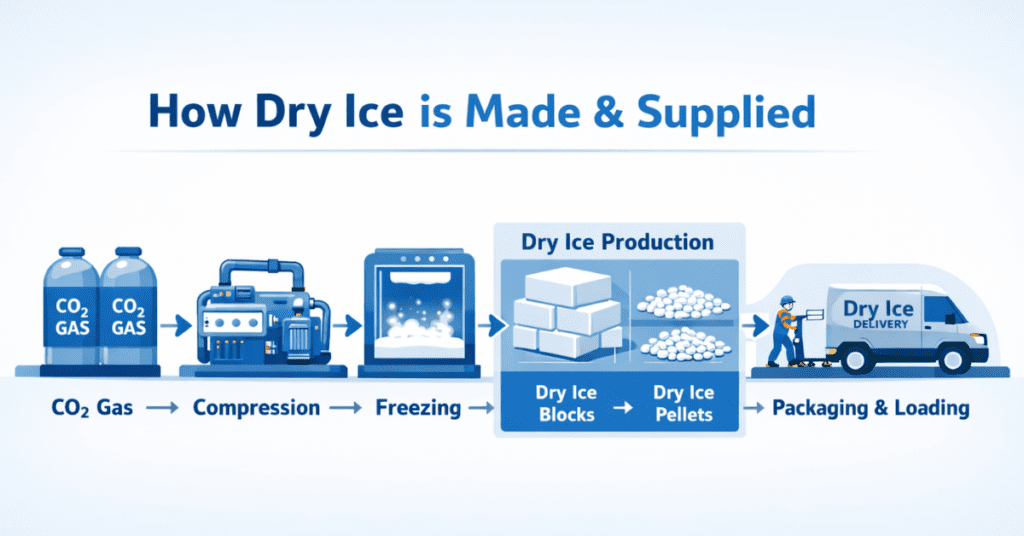
Let me break this down in a way that makes sense. Dry ice doesn’t grow on trees or get mined from the earth. The raw material is carbon dioxide gas, and the manufacturing process is all about manipulating temperature and pressure to skip the liquid phase entirely. That’s right: we go straight from gas to solid.
Here’s where it gets interesting. Carbon dioxide exists everywhere around us, but commercial dry ice production typically starts with industrial byproducts. Factories making ammonia, ethanol, or other chemicals produce CO2 as a natural consequence of their processes. Smart manufacturers capture this waste gas instead of releasing it into the atmosphere. It’s recycling at its finest, honestly.
The purification stage is crucial and absolutely non-negotiable. You can’t just compress any old CO2 and expect quality dry ice. The gas needs to be medical-grade pure, especially for food applications. We’re talking 99.99% purity levels here. Any moisture, oil, or contaminants get stripped out through multiple filtration stages.
This meticulous attention to quality matters tremendously when you’re looking to Find Dry Ice near me for restaurants, medical facilities, or any application where purity directly impacts safety and effectiveness.
What Happens During Compression and Expansion?
Now we’re getting to the magic part. The purified CO2 gas enters massive compressors that squeeze it down to approximately 870 psi. That’s about 60 times the pressure in your car tires. This compression alone doesn’t create dry ice, though. It creates liquid CO2, which might sound counterintuitive given what I said earlier about skipping the liquid phase.
But here’s the clever bit: when you suddenly release that pressurized liquid CO2 into normal atmospheric pressure, thermodynamics takes over. The rapid expansion causes the temperature to plummet instantaneously. We’re talking about going from liquid at room temperature to solid at minus 78.5 degrees Celsius in the blink of an eye. Some of the CO2 vaporizes immediately, carrying away heat and freezing the rest into snow-like crystals.
This CO2 snow gets collected in what looks like a giant snow cone maker. The fluffy white material has the consistency of fresh powder snow, except it’s sublimating constantly, creating that characteristic fog. At this stage, it’s not yet in the form most customers want. That’s where the next step comes in.
The temperature drop during expansion is dramatic and happens almost instantaneously. Imagine liquid CO2 at around -20°C suddenly exposed to atmospheric pressure. Within milliseconds, it plummets to -78.5°C. This rapid transformation explains why the snow appears so quickly and why production facilities need robust safety protocols.
What’s particularly fascinating about this process is its efficiency. Modern production facilities can convert up to 40% of the liquid CO2 into solid dry ice, with the remaining 60% vaporizing during the cooling process. That might sound wasteful, but it’s actually quite remarkable considering the thermodynamic challenges involved. The vaporized CO2 gets recaptured and recompressed, creating a closed-loop system that minimizes waste.
The collection chambers where the snow accumulates operate at controlled temperatures and pressures. Engineers carefully monitor these conditions because even slight variations can affect the final product’s density and sublimation rate. Too warm, and you get loose, fluffy snow that sublimates rapidly. Too cold with excessive pressure, and you might get uneven crystallization that creates quality issues down the line.
How Does Dry Ice Transform From Snow to Pellets and Blocks?
The CO2 snow gets fed into hydraulic presses that compress it into dense blocks or extrude it through dies to create pellets. Think of it like pasta-making, but with sublimating ice instead of dough. The pressure forces the snow crystals together, eliminating air pockets and creating solid dry ice with consistent density.
For blocks, massive rectangular molds receive the snow and get compressed under several tons of pressure. These blocks typically measure around 10 inches by 10 inches and weigh approximately 22 kilograms. They’re perfect for shipping temperature-sensitive goods over long distances because their lower surface-area-to-volume ratio means slower sublimation rates.
Pellets, on the other hand, come in various diameters. The most common sizes in Abu Dhabi are 3mm, 9mm, and 16mm. Each size serves different purposes:
Small pellets (3mm) work brilliantly for blast cleaning applications where you need gentle abrasive action without damaging substrates
Medium pellets (9mm) are the workhorses for shipping and cold chain logistics, offering a great balance between handling ease and cooling power
Large pellets (16mm) excel in industrial cooling applications where maximum cold retention matters more than surface contact
The extrusion process for pellets is continuous, with the snow getting pushed through circular dies at controlled rates. The extruded rods break naturally into pellet lengths as they exit the die. No cutting required, which is pretty neat when you think about it.
The density of the final product matters tremendously. Under-compressed dry ice sublimates too quickly, making it impractical for most applications. Over-compressed dry ice becomes brittle and prone to shattering, which creates handling difficulties and safety concerns. Manufacturers aim for that sweet spot where the pellets or blocks are dense enough for slow sublimation but not so compact that they become fragile.
Quality control happens throughout the compression stage. Operators monitor pellet diameter, density readings, and visual appearance. Any deviation from specifications triggers immediate adjustments to the hydraulic pressure or extrusion speed. This attention to detail ensures every batch meets the same high standards that customers expect.
The blocks require special handling immediately after pressing. They’re extremely cold and fragile for the first few minutes after formation. Workers use specialized gripping tools and transport carts designed specifically for dry ice. The blocks get transferred directly into insulated storage containers where they stabilize and develop their characteristic hardness.
Temperature monitoring continues even during storage. While dry ice is obviously cold, maintaining optimal storage conditions prevents unnecessary sublimation loss. The storage areas feature thick insulation, minimal air circulation, and careful inventory rotation to ensure customers always receive the freshest product with maximum remaining life.
Is Dry Ice Food Grade in Abu Dhabi? Quality Control Standards Explained
This question comes up constantly, and rightfully so. When you’re using dry ice to preserve food or create cocktail effects, purity isn’t just nice to have. It’s absolutely essential. Food-grade dry ice must meet strict regulatory standards that govern every step from CO2 sourcing through final packaging.
In the UAE, reputable suppliers like DryiceAbudhabi follow international food safety protocols including HACCP (Hazard Analysis and Critical Control Points) certification. The entire production chain gets monitored for potential contamination risks. We’re talking about regular testing for:
Moisture content, which should be virtually zero
Oil and grease residues from compression equipment
Metallic particles from manufacturing machinery
Biological contaminants including bacteria and mold spores
Chemical impurities from the source CO2
The testing happens at multiple points. Initial CO2 gas samples before compression, mid-process checks during pelletization, and final product verification before packaging. Any batch that doesn’t meet specifications gets recycled back into the system. Zero compromise on this front.
This rigorous quality assurance is what separates professional Dry Ice in UAE suppliers from mediocre ones. Every step gets documented, creating a complete quality trail from raw CO2 through final delivery. Customers can request batch certificates showing test results for any shipment they receive.
How Does Dry Ice Get From Factory to Your Doorstep in Abu Dhabi?
Distributing dry ice presents unique challenges that don’t exist with regular ice or most other products. You’re dealing with a substance that’s constantly sublimating, losing approximately 5-10% of its mass every 24 hours even under optimal storage conditions. Time becomes everything in this business.
The supply chain starts the moment dry ice exits the production press. Workers immediately transfer blocks and pellets into specialized storage containers. These aren’t your typical freezers, by the way. Dry ice storage requires insulated containers that allow CO2 gas to vent safely while minimizing heat transfer from the environment.
Most suppliers in Abu Dhabi maintain strategically located distribution centers across the emirate. This geographic spread reduces delivery times dramatically. When you place an order for same-day delivery, the logistics system automatically routes your request to the nearest facility with available inventory.
The logistics software behind these operations is surprisingly sophisticated. It tracks real-time inventory levels at each location, monitors traffic patterns across Abu Dhabi, calculates optimal delivery routes, and even factors in weather conditions that might affect sublimation rates. All of this happens automatically within seconds of order submission.
Distribution centers operate on a just-in-time model. Rather than stockpiling massive quantities that would sublimate away, they coordinate closely with production facilities to maintain optimal inventory levels. Fresh batches arrive throughout the day, timed to match anticipated demand patterns. This approach minimizes waste while ensuring product availability.
During peak seasons, particularly summer months when cooling demands spike, distribution networks shift into high gear. Additional production runs, extended operating hours, and temporary storage expansions ensure supply keeps pace with demand. The industry has learned from experience that running out of stock during a heatwave means losing customers who can’t afford to wait.
What Makes Dry Ice Transportation Different From Regular Ice?
Regular ice melts into water. Inconvenient, sure, but not particularly dangerous. Dry ice sublimates directly into CO2 gas, which can displace oxygen in enclosed spaces. This means every transport vehicle needs proper ventilation systems. Drivers receive specific training on handling protocols and emergency procedures.
The packaging itself tells a story about engineering problem-solving. Most deliveries use expanded polystyrene (EPS) containers, sometimes called styrofoam boxes, with varying thicknesses depending on delivery distance and ambient temperature. For longer routes during summer months when Abu Dhabi temperatures soar past 45°C, double-walled containers with vacuum insulation come into play.
Here’s something I find fascinating: the containers always include venting mechanisms. Completely sealing dry ice creates pressure buildup as sublimation continues. Those little holes you might notice in delivery boxes aren’t defects. They’re deliberate safety features that allow gas escape while maintaining insulation effectiveness.
Delivery vehicles themselves get equipped with temperature monitoring systems. Real-time tracking doesn’t just tell customers where their order is; it monitors cargo bay temperatures to ensure optimal preservation conditions throughout transit. If temperatures rise unexpectedly, the system alerts both driver and dispatch center immediately.
This level of sophistication in logistics is what makes modern Dry Ice supply near me services so reliable. The entire delivery chain operates with precision timing and constant monitoring to ensure you receive product in optimal condition.
Where Can I Buy Dry Ice in Abu Dhabi? Local Production Advantages
The UAE has developed a robust local dry ice manufacturing industry over the past decade. This wasn’t always the case. Ten years ago, most dry ice got imported from neighboring countries, which meant longer lead times, higher costs, and quality concerns from extended storage periods.
Local production changed everything. DryiceAbudhabi operates state-of-the-art facilities right here in the emirate, producing fresh dry ice daily. This proximity to end users creates multiple advantages:
Fresher product with minimal sublimation loss before delivery
Faster response times for urgent or same-day orders
Better pricing due to eliminated import costs and duties
Consistent quality control under local regulatory oversight
Reduced environmental impact from shorter transportation distances
The industrial zones around Abu Dhabi provide ideal conditions for dry ice manufacturing. Many facilities locate near petrochemical complexes that produce abundant CO2 as a byproduct. This geographical synergy means shorter CO2 transportation distances and lower raw material costs, savings that often get passed to customers.
Can I Get Same-Day Dry Ice Delivery in Abu Dhabi?
Absolutely, and this capability has transformed how businesses and individuals access dry ice. Modern suppliers operate sophisticated online ordering platforms that process requests 24/7. The system works remarkably smoothly.
You log onto the website, specify your requirements (pellet size, quantity, delivery time), and submit the order. Behind the scenes, the platform checks inventory at nearby distribution centers, calculates optimal delivery routes, and confirms availability within minutes. Most same-day orders placed before noon get delivered the same afternoon.
Emergency orders receive priority handling. Restaurant freezer breaks down? Medical facility needs immediate cold storage? The system flags these as urgent and dispatches from the closest location with available drivers. I’ve seen turnaround times as quick as 90 minutes from order submission to doorstep delivery.
Payment options include cash on delivery, credit card, corporate accounts, and bank transfer. Business customers often establish standing orders that automatically replenish inventory on predetermined schedules. This automation eliminates the stress of monitoring stock levels and placing repeat orders manually.
What Are the Uses of Dry Ice in Abu Dhabi? Industry Applications
The applications span far wider than most people realize. Sure, everyone knows about keeping ice cream frozen during transport or creating spooky fog effects at parties. But the industrial and commercial uses showcase the real versatility of this remarkable substance.
Each application demands specific pellet sizes and quantities. Event planners typically order smaller amounts of larger pellets for maximum visual impact. Restaurants and caterers prefer medium pellets in bulk for consistent cold chain maintenance. Industrial clients often need specialized delivery schedules coordinated with production cycles.
How to Handle and Store Dry Ice Safely? Essential Safety Guidelines
Let’s talk about something crucial that doesn’t get enough attention. Dry ice is incredibly useful, but it’s also potentially hazardous if mishandled. The extreme cold can cause frostbite instantly, and the sublimating CO2 gas can create asphyxiation risks in confined spaces. These aren’t theoretical dangers. They’re real concerns that require proper precautions.
Personal Protection:
Always wear insulated gloves when handling dry ice. Never touch it with bare skin. The minus 78.5°C temperature causes immediate tissue damage
Use tongs or scoops for transferring small quantities. Your gloves provide protection, but tools offer even better safety margins
Wear safety glasses if breaking blocks into smaller pieces. Flying chips can cause eye injuries
Keep dry ice away from children and pets. The smoking effect attracts curiosity, but the consequences of contact aren’t worth it
Storage Requirements:
Never store dry ice in airtight containers. The pressure buildup from sublimation can cause explosions. Always use ventilated storage
Regular freezers aren’t suitable for dry ice storage. The extreme cold actually tricks the thermostat into shutting off, which then warms the freezer and wastes the dry ice
Expanded polystyrene coolers work best for short-term storage. They provide insulation while allowing gas venting
Store in well-ventilated areas. Basements, small rooms, and vehicle trunks are dangerous because CO2 gas is heavier than air and accumulates at floor level
Label storage containers clearly. Other people need to know what they’re dealing with
Ventilation Considerations:
This point deserves special emphasis. One kilogram of dry ice produces approximately 540 liters of CO2 gas. In an enclosed space, this gas displaces oxygen. The symptoms of oxygen deprivation include headache, dizziness, rapid breathing, and eventually unconsciousness.
I’ve heard stories of people storing large quantities in car trunks overnight or using dry ice for party effects in poorly ventilated rooms. These situations can turn dangerous quickly. The gas is colorless and odorless, so you won’t notice it accumulating until symptoms appear.
For indoor use, ensure adequate air circulation. Open windows, use fans, avoid enclosed spaces. For vehicle transport, crack windows even during air-conditioned drives. The temporary discomfort of hot air beats the risk of CO2 accumulation.
How Much Does Dry Ice Cost in Abu Dhabi? Pricing and Ordering Guide
Pricing varies based on several factors. Quantity ordered, pellet size, delivery distance, and urgency all influence the final cost. Understanding these variables helps you optimize your purchasing decisions.
Most suppliers offer volume discounts. Ordering 50 kilograms costs significantly less per kilogram than buying 5 kilograms. Businesses with regular needs benefit from establishing wholesale accounts that provide preferential pricing and priority service.
Delivery fees depend on location and order urgency. Standard next-day delivery across Abu Dhabi typically includes free or minimal delivery charges for orders above a minimum threshold. Same-day or express delivery commands premium pricing due to the dedicated logistics required.
Pellet size also affects pricing. Smaller pellets require more precise manufacturing controls and thus cost slightly more than standard sizes. The difference isn’t huge, but it exists. Large blocks generally offer the best value per kilogram because they’re simpler to produce and have lower sublimation rates during storage.
Smart ordering strategies can reduce costs significantly:
Plan ahead when possible. Next-day delivery costs less than same-day rush orders
Consolidate orders. Multiple small orders cost more than one larger order delivered to the same location
Consider standing orders for regular needs. Automated deliveries often qualify for better pricing
Order only what you need. Dry ice sublimates regardless of use, so excess inventory becomes wasted money
Compare total cost including delivery, not just per-kilogram pricing. The cheapest unit price might have high delivery fees that eliminate savings
What Sizes of Dry Ice Pellets Are Available for Order?
Suppliers in Abu Dhabi typically stock three primary pellet sizes, each optimized for specific applications. The 3mm pellets work perfectly for blast cleaning operations where you need gentle abrasive action. These small pellets accelerate quickly in blast equipment and won’t damage delicate surfaces.
The 9mm pellets represent the workhorse size. They’re versatile enough for most cooling applications while offering good sublimation resistance. Restaurants, catering companies, and event planners typically prefer this size because it balances handling convenience with cooling efficiency.
The 16mm pellets excel in situations requiring maximum cold retention. Their lower surface-area-to-volume ratio means slower sublimation rates. Industrial applications needing prolonged cooling periods benefit most from this size.
Minimum order quantities vary by supplier but typically start around 5-10 kilograms for delivery orders. Walk-in customers can often purchase smaller quantities, though per-kilogram pricing increases for these small purchases. DryiceAbudhabi accommodates both large wholesale orders and smaller individual needs.
Is Dry Ice Environmentally Friendly? Sustainability Perspective
The environmental profile of dry ice presents interesting contradictions. On one hand, the production process captures CO2 that would otherwise enter the atmosphere as industrial waste. This recycling aspect provides genuine environmental benefits. On the other hand, the energy-intensive compression and refrigeration stages consume significant electricity.
The net impact depends largely on the CO2 source. Manufacturers capturing waste CO2 from ammonia or ethanol production create no additional greenhouse gas burden. They’re essentially borrowing atmospheric carbon temporarily for cooling applications before releasing it back as gas. This cycle doesn’t add new carbon to the atmosphere.
Compare this to alternatives like conventional refrigeration or gel ice packs. Refrigerated transport requires continuous power consumption throughout shipping. Gel packs need petroleum-based materials for manufacture and create disposal waste. Dry ice sublimates completely, leaving zero waste and requiring no return logistics or cleaning.
The UAE’s push toward renewable energy improves the sustainability equation further. As solar and nuclear power replace fossil fuel generation, the carbon footprint of dry ice production decreases proportionally. Future dry ice manufacturing may operate on entirely clean energy, making it genuinely carbon-neutral.
What Innovations Are Shaping the Dry Ice Industry in UAE?
The dry ice industry isn’t standing still. New technologies and methodologies continuously emerge, improving efficiency, safety, and environmental performance. Abu Dhabi suppliers are at the forefront of adopting these innovations, driven by the emirate’s commitment to technological advancement.
Automation has transformed production facilities over the past five years. Robotic systems now handle many tasks that previously required manual labor, from loading compression chambers to packaging finished products. This automation improves consistency, reduces workplace injuries, and allows for 24/7 production when demand requires it.
Smart monitoring systems represent another significant advancement. Internet-of-Things sensors track temperature, pressure, humidity, and CO2 levels throughout production and storage facilities. This real-time data feeds into analytical systems that predict equipment maintenance needs, optimize production schedules, and alert operators to potential quality issues before they affect customers.
Energy recovery systems are becoming standard in newer facilities. The compression process generates substantial heat as a byproduct. Rather than simply venting this heat, modern plants capture it for other uses like heating water, warming office spaces during cooler months, or even feeding back into industrial processes. This waste heat recovery can reduce overall energy consumption by 15-20%.
Research into improved insulation materials continues to advance. Newer delivery containers use advanced vacuum-insulated panels that outperform traditional expanded polystyrene while being thinner and lighter. This means lower shipping costs, reduced sublimation losses during transit, and better environmental performance through material efficiency.
The integration of renewable energy directly into production facilities is gaining momentum. Some newer dry ice plants in the UAE incorporate rooftop solar arrays that offset a portion of their electricity consumption. While solar alone can’t power the energy-intensive compression equipment completely, every kilowatt-hour from clean sources improves the environmental equation.
Customer-facing technology has evolved significantly too. Mobile apps now let you track deliveries in real-time, adjust order quantities on the fly, and even scan QR codes on delivery containers to access product certificates and handling guidelines. This digital integration makes the entire ordering and receiving process smoother and more transparent.
Looking forward, the industry anticipates further innovations in pellet customization. Imagine ordering dry ice pellets in precisely the size and density needed for your specific application, manufactured on demand rather than selected from standard sizes. The technology to enable this level of customization is already being tested in advanced facilities.
Final Thoughts: Your Dry Ice Journey Starts Here
Understanding how dry ice is manufactured and supplied transforms it from a mysterious smoking substance into a sophisticated industrial product with fascinating chemistry. The journey from captured CO2 to those perfectly formed pellets sitting in your cooler involves precision engineering, quality control, and logistics coordination that most customers never see.
What started as industrial waste gas becomes an invaluable tool for countless applications across Abu Dhabi and the wider UAE. From preserving vaccines that save lives to creating unforgettable event moments, from enabling molecular gastronomy experiments to solving industrial cooling challenges, dry ice proves its versatility daily.
The local production infrastructure in Abu Dhabi means you’re never far from fresh, high-quality dry ice when you need it. Same-day delivery, food-grade certification, multiple pellet sizes, and competitive pricing make it easier than ever to access this remarkable substance.
Whether you’re running a restaurant, planning an event, managing a healthcare facility, or tackling an industrial project, quality dry ice supply matters. The difference between mediocre and excellent service often comes down to supplier reliability, product freshness, and delivery speed.
Ready to experience the difference that local production and professional service make? Visit DryiceAbudhabi online or contact their team to discuss your specific requirements. They’ll help you determine the right pellet size, quantity, and delivery schedule for your needs. Because when it comes to dry ice, you deserve a supplier who understands both the science and the service.
Frequently Asked Questions About Dry Ice in Abu Dhabi
Where can I buy dry ice in Abu Dhabi?
You can purchase high-quality dry ice from DryiceAbudhabi, which operates production facilities and distribution centers across the emirate with convenient online ordering and same-day delivery options.
Where to buy dry ice in Abu Dhabi for urgent needs?
For urgent requirements, DryiceAbudhabi provides same-day delivery service throughout Abu Dhabi with orders placed before noon typically arriving within 3-4 hours.
Do you provide dry ice delivery in Abu Dhabi?
Yes, DryiceAbudhabi offers comprehensive delivery services covering all areas of Abu Dhabi with standard next-day delivery and express same-day options for time-sensitive requirements.
How much does dry ice cost in Abu Dhabi?
Dry ice pricing in Abu Dhabi varies based on quantity, pellet size, and delivery requirements, with DryiceAbudhabi offering competitive wholesale pricing and volume discounts for bulk orders.
Is dry ice food grade in Abu Dhabi suppliers?
Absolutely, DryiceAbudhabi produces food-grade dry ice that meets international safety standards and HACCP certification requirements with rigorous testing for complete safety in all food contact applications.
What sizes of dry ice pellets are available?
DryiceAbudhabi stocks three standard pellet sizes: 3mm for blast cleaning, 9mm for general cooling and food preservation, and 16mm for maximum cold retention in industrial applications.
How fast is dry ice delivery in Abu Dhabi?
Standard delivery from DryiceAbudhabi typically completes within 24 hours, while same-day delivery for orders placed before noon arrives within 3-4 hours across Abu Dhabi.
Can I get same-day dry ice in Abu Dhabi?
Yes, same-day service is readily available through DryiceAbudhabi’s delivery network, with the online ordering system automatically checking inventory at nearby distribution centers for immediate confirmation.
What are uses of dry ice in Abu Dhabi?
Dry ice applications in Abu Dhabi include food service cold chain shipping, healthcare vaccine transport, industrial blast cleaning, special effects for events, aviation catering, and construction concrete cooling with DryiceAbudhabi serving all sectors.
How to handle and store dry ice safely?
Safe dry ice handling requires insulated gloves, proper ventilation, and ventilated storage containers, with DryiceAbudhabi providing detailed safety guidelines with every delivery to ensure proper handling practices.